Showing posts with label books. Show all posts

Friday, December 31, 2010

2010 year in review - literary edition

Fifty.

That was the goal, and on December 26, I finished Oil by Upton Sinclair, my 50th book of 2010.

I shared this goal a while back as a way to motivate myself to keep learning. It worked. I learned, for example, about

  • The 14th Century (A Distant Mirror by Barbara Tuckman)
  • Running (ChiRunning by Danny Dreyer)
  • Randomness (The Black Swan by Nassim Taleb)
  • Lewis and Clark (Undaunted Courage by Stephen Ambrose)
  • Ebola (The Hot Zone by Richard Preston)
  • Leadership (Next Generation Leadership by Andy Stanley, among others)
  • Philosophy (Plato and a Platypus Walk Into a Bar... by Cathcart and Klein)
  • Social networking, childhood disorders, personal finance, communication, trans-racial adoption, evolving definitions of manhood, etc.
The fastest reads took only a day. The longest was about 10 months. The average, obviously, was about a week. Many of the books were in audio form, allowing me to make good use of commute time. One was on a Kindle. Most were borrowed from the library.

When I set the goal of 50 books, I wasn't sure if it was reasonable, or even possible, what with three kids and all. I'm a fast reader, though, and having the goal kept me focused on continuing to read. Like any discipline, just keeping at it is the most helpful thing.

The thing that struck me toward the end of the year, though, was how many more books I haven't read than those I have. 50 is a small number next to the 10 on my bedside table, the 87 on my library list, and the 130+ on my Amazon list. Taleb (in The Black Swan), talks about the importance of the unread books. So I'm OK with having more unread books than read ones, but for 2011, I am making more specific goals than a simple number. In the interest of public accountability, here are 2011's book goals:
  • 25 books by dead people. This will force me out of my tendency to read fluffy business books and encourage a little more intensity of material. (Note that while this does allow me to count Peter Drucker and Robert Jordan, I am counting on my good faith to not abuse them for the sake of the goal.) Specifically, I'd like to include at least
    • The Old and New Testaments (counts as 2 books, not 66)
    • One Shakespearean play
    • One classic Greek drama/tragedy/comedy
    • One 19th Century British
    • One Russian
    • One Southern writer (I may not actually be able to stomach this)
    • One famous philosopher
    • One church father
  • 3 books on personal finance
  • 3 books on parenting
  • 3 books on energy
  • 3 books on marriage
  • All the books currently on my nightstand
That totals to 47, though there will be some overlap between categories. The rules are the same, I have to "read" the whole book, and finish it during 2011's calendar year. Audio books are encouraged, and the Kindle will play a much bigger role now that I have one of my very own. The clock starts in 90 minutes. Game on.

This post has been pretty self-centered, and there's probably not much here for others to actually read. With a quarterly posting schedule, I don't count on many readers anyway. If you've made it this far, though, I'd love to hear what your read in 2010, what your plans are for 2011, and if you've got any recommendations for my list. Happy New Year, and happy reading.


PS - For those who are curious, the complete list in order of completion can be found here. I've put my top five recommendations in italics, though there are plenty of good ones on there (and a few I'd skip). If you'd like additional thoughts on any of them, let me know.


Thursday, March 25, 2010

How are you learning?

50 books.

That's my reading goal for 2010. In addition to blogs, magazines, and whatever else, my goal is to read 50 books by year-end. No limits on the genre, length, or quality...just 50 books. With 13 to date in the 1st quarter, I'm on track.

I have chosen this goal because books open up new worlds to me. New ideas, new facts, new ways of thinking; they all come to me through books. I read for entertainment, but above all, I read to learn. Learning leads to growth, and without growth, there is only decay. So despite all the demands on my time, I read.

The point of this post is not, however, to impress you with my reading goal (many people read more). Nor is it to encourage you to read more (though I think that's always a good idea). Rather, it is a question of learning. Specifically,

How are you learning?

If not through books, what? How? Are you listening to Open University courses? Online training sessions? Attending lectures? Blogs, magazines, newspapers?

Life keeps moving. The only way to keep up is to grow, and without learning, there is no growth. How are you keeping up? How are you learning?

(That last question is not rhetorical. I know how I'm learning, and I'm curious...how are you learning?)

Wednesday, December 30, 2009

Best books of 2009

As 2009 draws to a close, I thought I would look back at the books I have read this year. My reading tends to cover a pretty broad range, so instead of picking a single set of "best" books, I will give the award in several categories. To be on this list, the book must meet two criteria:
  1. I must have read (or listened to, in the case of audiobooks) the book in its entirety, and completed it in the 2009 calendar year. I am in the middle of a couple right now that would make the list if I were to finish them before December 31. I won't, though, so they can go on next year's list. This limits the candidate pool to about 35 books.
  2. The book must be worth reading. By using categories, I could easily recommend everything ("Best Book to Read After All Quality Literature is Confiscated"), but I won't. If it is on this list, it won't waste your time. 
Best Book for Getting Your Butt Off the Couch
Born to Run by Christopher McDougall
I wrote about a lack of inspiration before reading this book. I then read it and was inspired. McDougall tells the story of a tribe of Native Americans who run. A lot. He talks about humanity's prehistoric running and the possibility that we (Homo Sapiens) out-competed the Neanderthals because we were better distance runners. Most amazingly, he describes a persistence hunt, where African bushmen literally run an antelope to death. It made me want to run a marathon, and no book (or anything else) has ever done that before.

Best Book for Learning What Everyone Should Know
Basic Economics by Thomas Friedman
Most of what I have to say about Friedman's book, I have already said. I tweeted at one point that no one should be allowed to have an opinion about anything until they have read this book. That stance is a little strong, but it is a decent place to start. Life involves trade-offs, and economics is the science of those trade-offs. If you do not have a basic grasp of those, the reality of the world will smack down anything you attempt. Everyone should already know this stuff, but very few people talk like they do. Don't be in the majority on this one.


Best Book for Reading about Writing
On Writing by Stephen King
I have never read any of King's fiction, and do not really plan to. His genre does not appeal to me, but his philosophy of writing is well written. He says little that others have not said, but he says it as well as anyone. Read a lot, write what you care about, and write a lot. He probably implies a greater likelihood of success than is really out there, but otherwise he is dead on. It applies to most of life, too. Work hard at what you care about, and the rest will follow.


Best Book for Rethinking Education
Weapons of Mass Instruction by John Taylor Gatto
I posted a couple snarky items inspired by this book (here and here). I cannot say I am particularly proud of them, but the book's immediate effect was to really get me down on institutional schooling (including, but not limited to, public schools). As a product of America's public school system, the book made me feel shortchanged. Gatto is an evangelist, and preaches hard. The reason to read this book is not, however, to pull your kids out of public school and join a commune. The book forces us to think about things that we normally do not, but are very important. What is education? Why do we go to school? Why bother learning at all? What should we learn? No matter what education decisions you make for your kids, you owe it to them to make the decisions consciously, and this book will not let you do otherwise.


Best Cookbook
The Breath of a Wok by Grace Young and Alan Richardson
My family gave me a wok for my birthday earlier this year, which I had wanted for a while. This book came from the library to train me in the art of wok cooking. A random selection that was a wonderful experience to read and cook from. I posted about it here, and of all the wok-books I have read, it still remains the most inspiring and useful.


Best Books for Dads
Strong Fathers, Strong Daughters by Meg Meeker and The Way of the Wild Heart by John Eldredge
Since I have had kids, I have tried to channel some of my reading into learning about being the dad they deserve. I have a long ways to go. I am learning, though. I have both sons and a daughter, so I read books this year covering both of them. I described Meeker's book earlier. Eldredge's book is both for fathers and men in general, following up on his earlier Wild at Heart. This one goes into detail about the stages of the masculine journey and how we can lead our sons (and ourselves) through them. The translation of Eldredge's ideas from his (apparently) idyllic Colorado mountain ranch to the suburbs of Houston is always difficult for me, but the effort is worthwhile. Intentionality in raising our kids is always better than simply going with the flow.


Best Book by Dad
Spycraft by Robert Wallace and Keith Melton
My dad has written three books, and Spycraft is the best of them (though I have only started the third). It tells the story of the Office of Technical Services (OTS), the CIA's gadget-geeks, from the 1940's to the 1990's. Operations are described with a focus on the cool gear, making much of the book read like a James Bond film told by Q. The Cuban prison chapter is worth the price of the book on its own. Plus, if you're looking for an autographed copy, I can probably arrange something.


Best Book to Make You Stop Reading This Blog
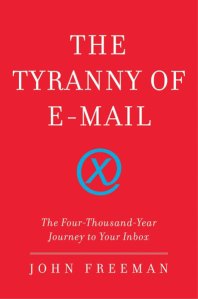
The Tyranny of Email by John Freeman
The final book in the list, and one of the last books I read this year (it was a Christmas gift), may have the least literary value, but the biggest impact on my day-to-day life. It is a call to slow down communication and unplug from the internet just a little bit. I wrote more about it here, and some of the other thoughts it raised here and here.

In the end, I hope you do not stop reading my blog. If you do, though, I hope it is to make time for books like these. Books open the world in a way blogs and Twitter and cable news never can, and we all need more of them in our lives. Read. A lot. And let me know what your best books of 2009 were. I'm always looking for ideas.

Monday, December 28, 2009

The Tyranny of Email


I just finished The Tyranny of Email by John Freeman. It prompted the last couple of posts, so a review of sorts seems worthwhile.

Summary: The communication patterns resulting from internet connectivity (primarily represented by email) are unlike anything humans have ever encountered before, and they are killing us.

That message is not particularly novel, complaints about email are nearly as ubiquitous as email itself. Nor is the last chapter of advice for dealing with it anything that has not been written on productivity blogs for years. That said, you should read it.

The core of the book traces the development of communication, primarily examining the speed with which we have been able to exchange information. Freeman writes well, making the story interesting and engaging. Most importantly, it puts the last 15 years of the internet into a little bit of context, which is an angle I have not read elsewhere.

As a result, the call for slowing down communication at the end has greater weight than that from a techno-phobe or productivity guru. In light of how we are wired, constant, rapid-fire communication appears to have no benefit and plenty of detriments to our social and psychological well-being.

Read the book, slow down, and talk to someone without a keyboard.

Saturday, December 26, 2009

News Gluttony

Reading through a Christmas gift, I came upon the story of the second telegram sent by Samuel Morse, "HAVE YOU ANY NEWS?" It (along with the rest of the book) has me thinking about the nature of news.

We seem to be wired for news. Stories of the past often involve isolated towns or homes eagerly awaiting letters or visitors or messengers bringing news. In general, news is something that comes from outside, something that we have not personally been a part of. My birthday party is not news to me, but yours (which I was unable to attend) is.

For most of human history, news was a rare thing. We got news only occasionally, and it was a treat, like a special dessert on holidays. The balance between our own experience (non-news) and that of others (news) was decidedly on the side of non-news.

Today, all this has changed. Thanks to the internet, news is everywhere. Nearly by definition, the internet is all news. Every email I receive, every blog I read, every Facebook album I browse is someone else's experience, that is, news to me. We are awash with news and are compelled to generate it ourselves, sending email and posting to blogs, Facebook, Twitter, and forums. The balance of our lives has shifted, significantly, away from non-news.

So I wonder, can we handle it? Our tendency to crave fat and sugar has gone from a benefit in a lean agricultural economy to a detriment in the land of buffets and drive-thrus.  Is our craving for news any different? Does the constant stream of news help us live better lives? Or is it contributing to mental gluttony with effects we cannot foresee (health impacts of extra weight have only recently been determined, after all)? Is one of those effects the erosion of the non-news part of our lives, the part that we are actually experiencing, not just reading about?

I am not the first to ask this question. This is the first time I have phrased it to myself in this way, though. It is making me think. How about you?

Friday, December 11, 2009

Strong Fathers, Strong Daughters

I just finished Strong Fathers, Strong Daughters by Meg Meeker (as an aside, I love starting and finishing a book so fast that it doesn't make it onto the sidebar list). I was pretty underwhelmed by the writing. It seemed a little random and disjointed, without a particularly coherent flow throughout.

That said, it still brought tears to my eyes a number of times. Not because of the powerful writing, but simply because she talks about the dangers my daughter will face as she grows up in the world. It made me want to lock her in her room and let her out when she's 25...maybe.

The book comes down to one message. A girl's dad is the primary force for good in her life, standing between her and the negative influence of the world (peers, media, her own emotions, etc.). Fathers abdicate that responsibility not at their own peril, but at hers.

Sobering stuff. I would recommend it to any dad with a daughter. The book is an excellent and humbling reminder of the power of fatherhood. I would also be curious to hear from women about the influence of your fathers. Does Meeker overplay a dad's importance? Or would you agree with her?

Sunday, December 06, 2009

The Power of the Limit

I recently wrote that I am inspired by extremes. Part of the reason is that I am a pretty moderate guy and I admire those that are willing to put it all on the line. The bigger part of the reason, though, is what the extremes can teach us about living in the middle more effectively.

In engineering, we talk about solving a problem "at the limit." For example, given an equation to solve, we determine the solution if x = 0. Or we look at the solution if x = infinity. Those problems are almost always easier to solve, which is nice, but they also give the limits for the solution. That is, if x is anywhere between 0 and infinity (and it often is), then the solution lies between the two limit solutions as well. By looking at the limits, we learn about the middle.

The same applies in our lives. Tim Ferriss became famous a couple years ago with a book called The Four Hour Workweek. In it, he talks about extreme strategies for maintaining your job (that is, income) while working only four hours a week. This is a solution near the limit. It is extreme, and very few of us will ever be able to support our families on four hours a week of work. However, the book is still useful because it forces us to think about how to cut down on work so that more time is available for other things. Cutting a workweek from 50 hours to 40 hours is not extreme, but the extreme can help show you how to do it.

Other extremes that can get your mind going:
  • What would my life look like if I were independently wealthy?
  • How would I structure my day if I did not need to sleep at all?
  • What would my priorities be if I knew I would live forever? If I knew I had 3 months?
  • How could I plan a week-long vacation with a budget of $50?
  • What would I do with 6 months of vacation every year?
  • What would happen if I said "yes" to every request for a month? What about "no"?
By thinking about the extremes, it is amazing how the options open up in the middle. What extremes have you contemplated? How has that affected your life?

(Photo credit to Cristóbal Alvarado Minic. Bonus to those who can identify the equation without clicking on it.)

Friday, November 27, 2009

Oscillation

As we all (in the US) recover from Thanksgiving, I am thinking about oscillation. The idea of moving between two points, back and forth, in some sort of rhythm. They talk about this in The Power of Full Engagement, increasing energy reserves and strength through cycles of stress and recovery. Today we are recovering from yesterday's stress of gluttony and hopefully not repeating it too much.

The central point in the book is that our optimum energy building comes from properly balancing stress and recovery, neither overtraining (too much stress) nor undertraining (too much recovery). It is a challenging notion, since our lives run linearly so often. At work, we work hard all day long, with barely time to eat lunch. Or perhaps we hardly work at all, doing the minimum to get by. I have done both, and they both leave me exhausted at the end of the day.

Physically, mentally, emotionally, spiritually, we need stress, effort, and exertion to test our muscles and force more from ourselves than we thought possible. Then we need recovery to rebuild and regroup for the next effort. Too much of either one and we burn out or atrophy. The right balance and the sky is the limit.

I tend to undertrain in most areas. How about you? How are you oscillating?

Sunday, November 22, 2009

Rules of Thumb

I just finished Alan Webber's Rules of Thumb. I liked it for a couple reasons. The first is that each chapter covers one of 52 rules of thumb. Each one is short and self-contained. That makes it easy to read in bits and spurts while watching kids...a big plus for a book these days.

The second is how he validates carrying 3x5 cards in your pocket. The rules that the book covers are simply bits of business wisdom that Webber has picked up over the years and recorded on 3x5 cards that he carries with him everywhere. My father does the same thing, and I never really understood it...until I started to as well.

The 3x5 card is not really the point. The point is that our brains are pretty bad at actually remembering things. Which means when you have an idea, or read a powerful quote, or hear a rule of thumb, you better write it down...pronto. Use 3x5 cards, a Moleskine journal, an iPhone app, whatever. Just write it down.

Who knows, maybe someday you can write a book.

Saturday, October 17, 2009

Lessons from the Little Engine

Yet another book I have finished recently is The Little Engine That Could. In fact, my toddlers have encouraged me to finish it a couple times a day for the last several weeks. That has given me lots of time to see the brilliant lessons it contains that make it a timeless classic.


Enjoy your work
"She was a happy little train for she had such a jolly load to carry."
The first character we encounter in the book is a happy little train who enjoys her work. As we will learn later on, she does not have the most important or fanciest of jobs, but her load was jolly, and she enjoyed it.


Leadership involves action 
"'Here comes a shiny new engine,' said the funny little clown who jumped out of the train."
The only doll who actually does anything in the book is the "funniest little toy clown you ever saw." The other dolls and toys spend their time whining or crying or being sad. The clown jumps out of the train and waves his flag and as a result is the default leader of the group, despite his red nose and blue bow-tie.


Always be polite 
"Please, Shiny New Engine..."  
"Please, oh, please, Big Engine..."  
"Please, Kind Engine..."  
"Please, please, help us, Little Blue Engine."
What's the magic word? There is no guarantee that it will work, but saying "please" is always a good idea, particularly when desperate. Notice that after several rejections, the clown is still polite. That is good leadership.

Don't give up.
"Here is another engine coming...Let us ask him to help us."  
"Here comes another...perhaps he can help us."  
"Here is another engine coming...maybe she will help us."
The first three requests for help were turned down. Only on the fourth did the dolls and toys get the ride over the mountain they needed. If at first you don't succeed, try, try again. Persistence can pay off.

Don't close your eyes to possibilities.
"...the boys and girls on the other side won't have any toys to ply with or good food to eat unless you help us."  
"...won't have any toys to play with or good food to eat unless you help us."
"...unless you help us."  
"...unless you help us." (emphasis mine)
During every request, the clown repeats the same message, that disaster will strike unless you help us. Yet 75% of the engines surveyed did not help and the boys and girls still had food and toys. While the statement may be simply part of a hard sell on the part of the clown, it reads like he is putting all his hopes on a single engine savior at a time. There is always an alternative, do not get locked into the choice in front of you to the exclusion of all else.

Stay positive. 
"The Passenger Engine is not the only one in the world."
"He looks very old and tired, but our train is so little, perhaps he can help us." 
Sometimes the best thing to do is to put on a brave face and keep going. So what if the big Passenger Engine just blew you off? Maybe the Rusty Old Engine has one more trip over the mountain in him. Chin up now, everybody all together, "the sun'll come up, tomorrow!"


Try new things.
"I have never been over the mountain."
So what if you haven't been over the mountain? Metaphorically or physically, there is no need to let the fact that you have never been over the mountain before stop you from going over it now.


Take control of your own destiny.
"Here comes a shiny new engine...Let us ask him to help us."
Besides taking action in general, the funny little clown leads by taking control of his own destiny. At the beginning of the story, he's a passenger, riding a train wherever it takes him. When that train breaks down, though, he jumps out and takes charge. Knowing that he wants to be on the other side of the mountain, he makes it happen. Are you riding a train, or flagging one down?


Care about others.
"'What is the matter, my friends?' she asked kindly."
The Little Blue Engine is kind from the beginning, and through her kindness is given a chance to climb the mountain into literary history. The book is not named for the arrogant Passenger Engine or the gruff Freight Engine, but rather for the kind Little Blue Engine.

There's nine lessons without even mentioning the "I think I can" tagline. What else have I missed? What other so-called children's books would you use as a life coach?

Friday, October 16, 2009

Uprising, or why you should just give up

I recently finished Erwin McManus' Uprising: A Revolution of the Soul. In general, I appreciate his straightforward style and non-sissy Christianity. Unfortunately, I have nothing to say about this particular book. Nothing good, nothing bad. All I learned was that taking too long to finish a book is just as pointless as not finishing at all.

I started the book in February of this year, meaning it took nine months or so to get through it. In the meantime, I started and finished about 20 other books (give or take). I did a lot of other stuff, too: traveled, played with my kids, worked, slept, listened to podcasts, etc. So by the time I got to the end of the book, the conclusion had no meaning because I lost the point somewhere back in April.

Why am I sharing this? Partly because I thought I should write a review of the book and this is the best I can come up with. Mostly, though, I want to share some advice:

Give up.

That's right, give up. Sometimes the payoff of finishing something simply does not justify the cost. Many times we know that subconsciously, which is why we procrastinate. Then we pay a cost of guilt without even the meager reward of finishing. Plus, there is the opportunity cost of not doing something really valuable because we are too well conditioned to never give up.

What do you need to give up? A book? (Crime and Punishment has been haunting me for a decade.) A project? (A workshop in my garage? What workshop?) A relationship? (No examples from me on this one right now.) Go ahead, you have my permission. Give up and move on. You'll be glad you did.

Thursday, October 15, 2009

Basic Economics

I have made several references to this book, so it seems worthwhile to devote a post to it. I downloaded Thomas Sowell's Basic Economics: A Citizen's Guide to the Economy from Audible.com as part of a 3-for-2 special. A bit ambitious of me to go for a book on economics, but I was well rewarded.

Here's the summary:
A price-coordinated economy takes advantage of distributed knowledge to most efficiently allocate scarce resources to meet the desires of consumers.
Along the way, Sowell fleshes out a lot of details and give examples about how rent control leads to housing shortages and food price controls lead to overproduction and starvation (at the same time!). Throughout, he keeps coming back to the idea that knowledge is king and only free price fluctuations (i.e. a free market) can make use of knowledge quickly enough to be useful.

Another recurring theme is that the intent and effect of government intervention are not the same. A favorite line is that there are not enough economists for politicians to worry about when election time comes, so they can make policy without regard for actual effects understood by the specialists.

Missing from the book is a full treatment of so-called "externalities," which cannot be accounted for by price. What is the value of beauty, clean air, or human goodness? Attempts to fit such things into a price-coordinated economy will always be awkward and forced, but that does not negate their value.

I posted on Twitter at one point that Basic Economics should be required reading for anyone wanting to express an opinion about anything. That may have been a little strong, but not by much. The book reveals the logic behind economies, not matter how they are structured, and opens our eyes to how decisions today may affect the future. Words and meaning are two different things; Sowell tries to get past the first and into the second. He (or we) may not succeed all the time, but the effort is worth it.

Tuesday, October 13, 2009

Why read fantasy?

I just finished reading Rick Riordan's The Lightning Thief. It took me about four hours total, and I enjoyed it greatly. Why did I enjoy a mass market adolescent fantasy novel?
  1. Escapism. Sometimes it gets a little old to be constantly immersed in business, economics, and world crises. A 12-year old decapitating Medusa off the New Jersey turnpike makes for a nice change of pace.
  2. Clear good guys and bad guys. A good fantasy may have false trails and such in the middle, but at the end, the hero wins, the bad guy is defeated (at least until the next book) and I can sleep well. All is right with the world.
  3. Inspiration. Yes, it is fiction, but if a kid can confront Hades and sacrifice his own desires for the greater good, what is stopping me? Ender's Game is one of my favorite novels of all time for exactly this reason.
Any other good reasons to put down Drucker and Collins for a bit?

Monday, September 28, 2009

The End of Empire


On a whim, I recntly picked up The End of Empire by Christopher Kelly (Amazon link) at the library . It tells the story of the Huns in Europe with a focus on their interactions with the Roman Empire and their contribution to its fall. Fascinating stuff that I either missed in school or had forgotten completely.

(Aside: Support your public library. The only reason I picked up the book is because it was free to borrow, and as a result, I am better educated than I was. If you haven't visited lately, go. Get a random book or one you've had your eye on. You'll be glad you did.)

The history was interesting, and there were a couple lessons that are easily applied today.

  1. Barbarians are rarely barbaric. They are usually different, and may appear barbaric to outsiders. Do not be fooled, though. When someone looks or acts differently than you do, a quick assessment of equivalence between appearance and intelligence is an easy route to disaster, for an empire or an individual.
  2. Buying off a blackmailer is a good way to make the blackmailer rich while doing nothing to lessen the threat to your own security.
  3. Good politics today can destroy the state tomorrow. Keep the big picture in mind. 
  4. Excessive drink is a bad idea. Do you really want to risk being known for drowning in your own blood from a nosebleed experienced while passed-out drunk? Not the death a noble warrior king like Attila would have hoped for, I suppose.

Saturday, September 05, 2009

Love the wok

A couple months ago, my wonderful family bought me a wok for my birthday. I've been wanting one for a while, though once it arrived, I wasn't really sure what to do with it. How do you cook in a bowl?

The answer is found, like most, in my local public library. I checked out a handful of wok cookbooks, and have used recipes from most of them, but the one that stands out is The Breath of a Wok by Young and Richardson.

Part manual, part history, part travelogue, part cookbook, Breath covers a wide range of wok technique and lore with impressive photography. It went well beyond recipes and made me want to build a custom wok stove and fire it with dried rice stalks.

Realistically, I'm loving my Target wok on my gas-fired stove. We've done some Kung Pao chicken, garlic and snow peas, and some Italian-Chinese wok fusion pasta. All good stuff, tasty and fun.

So I now have two favorite pans, the cast iron skillet and the carbon steel wok. It's good to have variety, I suppose.

Thursday, September 03, 2009

The Goose - good for the gander, too.

I'm into learning stuff. One big group of stuff I like to learn about is personal leadership/productivity/improvement, and there's no shortage of books out there feed that need. So many, in fact, that there's no way I can read them all, or even a small fraction of them. Which is why The Goose is so fantastic.

They read books, summarize them, extract key nuggets (Golden Eggs) and send you an email every Tuesday with the information nicely written up. Since a lot of books contain no more than one or two original, useful ideas (if that), this saves a whole lot of time.

Check them out. You'll be glad you did.


Sunday, August 30, 2009

The Fifth Discipline (Peter Senge)

Nearly everything we do or experience is part of a system. It is the very rare circumstance where we can attribute cause and effect to independent entities. Yet we do it all the time.
"The Fed/housing bubble/Lehman Brothers caused the financial break-down."
"A public option will fix healthcare."
"I'm eating because I'm hungry."
All these statements have truth in them, but they are incomplete. They are incomplete because they leave out the system. They leave out the history, the other players, the unintended consequences, the emotions, and all the other subtle, critical influences.

The 5th discipline of Senge's title attempts to capture all that other stuff through "systems thinking." Everything is connected, and only by broadening our view to encompass the whole system will we ever understand what's really going on. If not, unintended consequences will reign supreme.

The other four disciplines, personal mastery, mental models, shared vision, and team learning, all feed into systems thinking, particularly as part of an organization. At one time, Shell excelled at this, but I'm no longer convinced it's part of the culture.

Although somewhat academic in style, the world today is too complex not to be moving toward thinking in terms of systems. If you're not doing it now, this classic is well worth reading.