The human digestive system works on a simple principle. Food goes in, waste goes out. Along the way, the body is nourished. Sometimes, though, something goes wrong and constipation results. Food goes in, nothing comes out. Along the way, the body hurts. Pain is a clear signal of malfunction.
The human spirit works on a similar principle. Food goes in, fruit goes out. Along the way, the spirit is nourished. Sometimes, though, something goes wrong and spiritual constipation results. Food goes in, nothing comes out. Along the way, the spirit hurts, but the signal it sends is more subtle than physical pain...(more)
This article was written for Lucid Magazine. Click here to read the rest of it and check out the other cool stuff.
Showing posts with label Spiritual. Show all posts
Showing posts with label Spiritual. Show all posts
Wednesday, March 31, 2010


Thursday, December 24, 2009
The Tipping Point of Faith
I have recently been enjoying an Open Yale course on game theory. The professor is entertaining and the subject fascinating. The last several lectures have been covering Nash Equilibria , those states of a game where no player can gain an advantage by changing their strategy or choice. This concept can help in understanding the best responses for each player and where the end state of a game could end up. An extension of the idea is that where two equilibria exist in a game, there may be a tipping point where different equilibria are favored depending on which side you are on.
As a geographic analogy, consider the Continental Divide. It is the tipping point in directing water in North America. Rain falling to the east ends up in the equilibrium known as the Atlantic, and rain to the west ends up in the Pacific.
As I was listening to this, it occurred to me that Nash Equilibrium could be a good description of something I have experienced and witnessed in the area of spirituality and faith. I think that the payoff for any given belief system could be crudely modeled like the following graph.

The scale runs from no belief on the left to complete belief on the right, with shades of belief in between. The vertical axis is the pay-off in terms of contentment, joy, happiness, peace, whatever.
At the far left, a non-believer is at peace with their decision. They operate free of the obligations and rewards of the belief system, choosing to do what works for them (possibly a different faith) and are therefore happy with life.
At the far right, a true believer is at peace with their decision. They are comfortable within the structure of the belief system, are privy to the rewards (community, eternal confidence, etc.) and are therefore happy with life.
In between are most people. Taking the evangelical Christian system as an example, these are the folks who claim belief in God, but never show up for church. Or the people who are in church but asleep. Or who open their Bibles only during Sunday school. Or who display an unopened Bible prominently on their coffee table. All of these folks are riding the fence in one way or another.
To bring back the Game Theory, the Nash Equilibria are, of course, on either extreme. The payoff is maximized at full belief or full non-belief. A rational player (one who is looking to maximize payoff) will always be forced to one side or the other, though the theory does not make any claim as to which side is preferred.
Faith is not generally amenable to mathematical analysis or simplified Game Theory. So clearly this does not tell the whole story. It does, however, remind us of something that gets easily hidden in the bustle of everyday life. Is our faith real? And if it is not, should we keep playing games? Are we happy in the middle, or does something need to change?
I would love to hear your where you stand on the questions or the theory. Leave a comment and let me know what you're thinking.
(picture credit to R. Brown)
As a geographic analogy, consider the Continental Divide. It is the tipping point in directing water in North America. Rain falling to the east ends up in the equilibrium known as the Atlantic, and rain to the west ends up in the Pacific.
As I was listening to this, it occurred to me that Nash Equilibrium could be a good description of something I have experienced and witnessed in the area of spirituality and faith. I think that the payoff for any given belief system could be crudely modeled like the following graph.

At the far left, a non-believer is at peace with their decision. They operate free of the obligations and rewards of the belief system, choosing to do what works for them (possibly a different faith) and are therefore happy with life.
At the far right, a true believer is at peace with their decision. They are comfortable within the structure of the belief system, are privy to the rewards (community, eternal confidence, etc.) and are therefore happy with life.
In between are most people. Taking the evangelical Christian system as an example, these are the folks who claim belief in God, but never show up for church. Or the people who are in church but asleep. Or who open their Bibles only during Sunday school. Or who display an unopened Bible prominently on their coffee table. All of these folks are riding the fence in one way or another.
To bring back the Game Theory, the Nash Equilibria are, of course, on either extreme. The payoff is maximized at full belief or full non-belief. A rational player (one who is looking to maximize payoff) will always be forced to one side or the other, though the theory does not make any claim as to which side is preferred.
Faith is not generally amenable to mathematical analysis or simplified Game Theory. So clearly this does not tell the whole story. It does, however, remind us of something that gets easily hidden in the bustle of everyday life. Is our faith real? And if it is not, should we keep playing games? Are we happy in the middle, or does something need to change?
I would love to hear your where you stand on the questions or the theory. Leave a comment and let me know what you're thinking.
(picture credit to R. Brown)
Friday, November 13, 2009
John Piper rocks my world
Noel Piper, John Piper's wife, has been posting their daughter's adoption story over the last couple weeks. One of the posts that stood out to me was a reproduction of John's letter voicing his agreement with the adoption. It highlights two challenges for me.
- A model of Biblical submission and love. Noel states several times that after many hours of discussion, the final decision would be John's - submission. In his letter, John states that Noel's heart's desire is the most important factor in his decision - love. He agrees to adoption not purely out of his own reasoning, but primarily to love and sacrifice for his wife. When was the last time I made a decision like that?
- Consistency of commitment and character. John makes it clear that after honoring his wife, adoption is a way to live a radical commitment to love, racial reconciliation, male/female role modeling, pro-life, and every area of his life's ministry. He is (and they are) willing to put their beliefs on the line visibly, publically, and irrevocably. Have I ever done that?
Sunday, September 20, 2009
Ignorance is bliss
Much of the time, perhaps too much of the time, I am convinced of the importance of something based on how much I hear about it. Not based on how relevant it is to my life, not based on how it affects those I love, but simply how many other people/blogs/ads are talking about it.
So when Seth Godin had a recent post about website design, it appeared to be a great post, not because I read it critically and came to that conclusion, but because that same day I saw it on at least two other blogs and two Twitter updates. That is a large portion of my web input.
The same goes for TV shows that advertise during football games, billboards on my way home, and National Hurricane Center updates during the summer and fall. Many things become overwhelmingly important to me.
Yet without the buzz, without the chatter, very little of that remains important to me. If I do not watch TV, I do not care what I am missing. When I recently watched a couple hours of USA while folding laundry, the lives of Adrian Monk and the noble detectives on Law & Order quickly became central to my being. A couple days later, they matter very little again.
All this reminds me that my attention and my desire are very fickle things. They are easily led about by the nose by whoever puts in the effort. Advertisers know this, and they put the effort in. Without a counterbalance, I will become a vessel for whatever others want, desiring their products, thinking their thoughts, believing their opinions. This is easy, but not the best way to live life.
The answer is to decide for myself what is important, what I want to value, and limit my input to those things. Selective ignorance is the phrase used by some. I choose who I follow on Twitter, I choose which blogs I read, I choose what TV I watch, I choose what news to listen to. Only by doing that will my life be mine and not an extension of NBC or NPR or GTD (unless I choose it).
So what is controlling your life? Are you? Why not?
So when Seth Godin had a recent post about website design, it appeared to be a great post, not because I read it critically and came to that conclusion, but because that same day I saw it on at least two other blogs and two Twitter updates. That is a large portion of my web input.
The same goes for TV shows that advertise during football games, billboards on my way home, and National Hurricane Center updates during the summer and fall. Many things become overwhelmingly important to me.
Yet without the buzz, without the chatter, very little of that remains important to me. If I do not watch TV, I do not care what I am missing. When I recently watched a couple hours of USA while folding laundry, the lives of Adrian Monk and the noble detectives on Law & Order quickly became central to my being. A couple days later, they matter very little again.
All this reminds me that my attention and my desire are very fickle things. They are easily led about by the nose by whoever puts in the effort. Advertisers know this, and they put the effort in. Without a counterbalance, I will become a vessel for whatever others want, desiring their products, thinking their thoughts, believing their opinions. This is easy, but not the best way to live life.
The answer is to decide for myself what is important, what I want to value, and limit my input to those things. Selective ignorance is the phrase used by some. I choose who I follow on Twitter, I choose which blogs I read, I choose what TV I watch, I choose what news to listen to. Only by doing that will my life be mine and not an extension of NBC or NPR or GTD (unless I choose it).
So what is controlling your life? Are you? Why not?
Wednesday, September 16, 2009
He who is faithful with little
Jesus once told a parable about a master and servants. Toward the end, he shares this line:
I was reading a book where this was discussed, and I was struck by how counter this is to my own way of thinking, which I think is a reflection of either the nature of man, current culture, or both.
Don't waste time with the small stuff...put me in charge of many things RIGHT NOW!
I have the education. I have the test scores. I've read Drucker and Collins and Lencioni. It is clearly a waste to put me in charge of only my own work, or just my kids, or some other small and (seemingly) insignificant responsibility. Paying your dues is such the Baby Boomer thing to do. We Gen XYZ-ers don't have time for that.
... ... ...
Color me convicted. Maybe there's some merit in demonstrating competence with small things before being entrusted with large ones. Humility is critical for great leadership, and expecting responsibility to be handed to me instead of earning it may indicate a touch of arrogance. Maybe just a little.
Well done, good and faithful servant! You have been faithful with a few things; I will put you in charge of many things. (Matthew 25:21)
I was reading a book where this was discussed, and I was struck by how counter this is to my own way of thinking, which I think is a reflection of either the nature of man, current culture, or both.
Don't waste time with the small stuff...put me in charge of many things RIGHT NOW!
I have the education. I have the test scores. I've read Drucker and Collins and Lencioni. It is clearly a waste to put me in charge of only my own work, or just my kids, or some other small and (seemingly) insignificant responsibility. Paying your dues is such the Baby Boomer thing to do. We Gen XYZ-ers don't have time for that.
... ... ...
Color me convicted. Maybe there's some merit in demonstrating competence with small things before being entrusted with large ones. Humility is critical for great leadership, and expecting responsibility to be handed to me instead of earning it may indicate a touch of arrogance. Maybe just a little.
Friday, September 11, 2009
Global Status of Evangelical Christianity
I like maps. They're a fascinating visual display of information, and here's a site with some that I'd never seen before. Enjoy!
www.worldmap.org
www.worldmap.org
Thursday, October 19, 2006
To a Thousand Generations (Douglas Wilson)
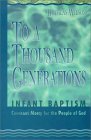 Prompted by the discussions and decisions of friends, and enabled by this book's unexpected presence on our shelf, I found myself reading about infant baptism while camping last weekend. Douglas Wilson's To a Thousand Generations is a short teatise by a former credo-baptist (one who believes in believer baptism) on the Biblical directive for infant baptism. As a credo-baptist myself (although I didn't know it before reading this book), I was fascinated to read the reasoning behind the other side for the first time.
As I understand it, the argument of a paedo-baptist (one who believes in infant baptism) centers around the continuity of the old and new covenants, drawing a clear parallel between circumcision and baptism. As birth members of the covenant race, Jewish infants were circumcised prior to demonstrating faith in Jehovah; therefore children of believing, faithful Christian parents are to be baptized as birth members of the new covenant without regard for their personal faith profession or demonstration.
This argument actually makes sense to me. It is, at least, internally consistent. However, I was not convinced of the irrefutable Biblical evidence that requires adopting a paedo-baptist viewpoint. The book hinges on the assumption of continuity between the covenants in specific areas, and requires a parallel between circumcision and baptism that I believe is credible, but far from conclusive.
My conclusion from reading the book was that my own credo-baptist position is not as unassailable as I once thought. At the same time, the evidence presented to change my mind was insufficient. I remain faithful to the credo-baptist position, but am more firmly convinced that those on either side of this issue must continue their arguments with the utmost grace and compassion, for in the end, baptism is a sign, and only the true transformative power of Christ matters.

