Showing posts with label live. Show all posts

Friday, January 08, 2010

Grand Adventures in Fatherhood


I have big dreams. Laying in bed, I dream about quitting my job and hiking the Appalachian Trail. I dream about running marathons...no, make that ultramarathons. I dream of taking a trip around the world, or just a month-long backpack through Australia. I dream of writing a book and starting a business and becoming a master cabinetmaker. The world is full of grand adventures, just waiting for me to get out of bed and get started.

Then my 18-month-old son wakes up crying. He wakes up his twin sister, and they start a chorus. So I climb out of bed, fill sippy cups with milk, and try to wake up before their 2.5-year-old brother gets out of bed. Soon enough, the volume level in the house increases ten-fold and I am reading Who Says Woof for the 10th time in a row while dreams of grand adventures fade quickly into the background.

Daily life with three kids under three can quickly become monotonous. They fight...again. They make up and play sweetly together...again. They yell, they eat, they throw food, they throw toys, we read board books...again. The dreams of a grand adventure grow bigger while the reality seems further and further away.

But does it have to be this way? Is fatherhood incompatible with the grand adventures of life? Of course not. Grand adventures are there, they just take a little more work. Here's how to make them happen.

  1. No excuses.
    When my second and third kids were born, my wife and I made a commitment that our kids would not be an excuse. Having toddlers does not excuse me from exercising, reading, blogging, traveling, or anything else. Never use your kids as an excuse to withdraw from the world or to postpone your dreams. By making excuses, we make our kids responsible for our lives, and it's not their problem. You are still the one responsible for you, and having kids does not change that.
  2. Get real.
    At the same time, we're responsible for them now, too. We have to be honest. Do you know who you are, who your wife is, who your kids are? Do you know energy levels, abilities to endure change, or physical requirements? Having three kids is different than having one. Having a 2-year-old is different than having a 12-year-old. A child with Down's Syndrome has different challenges than one with autism. You have to know the real boundaries in your life.
  3. Keep dreaming.
    The one thing that kids never do is prevent us from dreaming. In fact, they can expand the dreams. Now I not only dream of running a marathon, I dream of running a marathon with a triple-stroller. I dream not just of re-learning to play the piano, but of playing a duet with my son. Keep dreaming and imagining the greatest life possible for you and your family.
  4. Focus.
    Dreams are fun. Dreams lived out are even more fun. The trouble is, even without kids, trying to live all our dreams is a recipe for frustration. There is simply not enough time/money/energy to do them all. So focus. Pick one that you will commit to making happen. By taking the dreams one at a time, you can bring everything you have to bear on it and make it happen.
  5. Be creative.
    Once you have the dream and a realistic view of the world, it's time to get creative. How can they fit together? How can you find time to read? Where will the money for plane tickets come from? How can you build that sleigh bed without risking your 3-year-old's fingers in the table saw? You have defined a problem clearly and have committed to not making excuses. There is a solution. It just requires some creativity to find it.
  6. Recruit help.
    If you can achieve your dream on your own, then it's not a very big one. Small dreams are fine, but if you're dreaming big, you're going to need some help. The first person to recruit is your wife. If she isn't on your side, there are other blogs you should be reading. If your kids are old enough, recruit them. Look for other dads, in real life and online. Look for people who can support you physically (babysitting), emotionally (encouraging your dream), and mentally (helping brainstorm solutions). If you go it alone, you will likely fail. If you recruit help, you increase the chances of living the dream, and strengthen relationships along the way.
  7. Go.
    The last step is the hardest. You just have to do it. You have to buy the tickets, leave the house, and get on the plane with all three kids. All the dreaming and planning is meaningless until you go, take action, and live the dream.

Finally, there is a mental shift that happens. Men, in particular, are wired for big things, action things. We want to build, move, take action and have an impact. Our dreams tend in those directions. Fatherhood changes the game a little, though. Rocking a newborn to sleep at 3 in the morning is not bold. Listening to a 6-year-old's piano recital is not dramatic. Picking a 12-year-old up from school does not make the news.

This is where the shift happens, though. My son's excitement to see the elephant's bath at the zoo, my daughter's squealing when I come home after work, or my kids spontaneously saying "I love you" does things in my heart that no other dream can ever do. Fatherhood is the grandest of grand adventures. As you take action to make your other dreams happen, remember that simply being "Dad" is the greatest dream of all.

Now go and live it.

(Photo credit to jbrindes)

Monday, December 28, 2009

The Tyranny of Email


I just finished The Tyranny of Email by John Freeman. It prompted the last couple of posts, so a review of sorts seems worthwhile.

Summary: The communication patterns resulting from internet connectivity (primarily represented by email) are unlike anything humans have ever encountered before, and they are killing us.

That message is not particularly novel, complaints about email are nearly as ubiquitous as email itself. Nor is the last chapter of advice for dealing with it anything that has not been written on productivity blogs for years. That said, you should read it.

The core of the book traces the development of communication, primarily examining the speed with which we have been able to exchange information. Freeman writes well, making the story interesting and engaging. Most importantly, it puts the last 15 years of the internet into a little bit of context, which is an angle I have not read elsewhere.

As a result, the call for slowing down communication at the end has greater weight than that from a techno-phobe or productivity guru. In light of how we are wired, constant, rapid-fire communication appears to have no benefit and plenty of detriments to our social and psychological well-being.

Read the book, slow down, and talk to someone without a keyboard.

Saturday, December 26, 2009

News Gluttony

Reading through a Christmas gift, I came upon the story of the second telegram sent by Samuel Morse, "HAVE YOU ANY NEWS?" It (along with the rest of the book) has me thinking about the nature of news.

We seem to be wired for news. Stories of the past often involve isolated towns or homes eagerly awaiting letters or visitors or messengers bringing news. In general, news is something that comes from outside, something that we have not personally been a part of. My birthday party is not news to me, but yours (which I was unable to attend) is.

For most of human history, news was a rare thing. We got news only occasionally, and it was a treat, like a special dessert on holidays. The balance between our own experience (non-news) and that of others (news) was decidedly on the side of non-news.

Today, all this has changed. Thanks to the internet, news is everywhere. Nearly by definition, the internet is all news. Every email I receive, every blog I read, every Facebook album I browse is someone else's experience, that is, news to me. We are awash with news and are compelled to generate it ourselves, sending email and posting to blogs, Facebook, Twitter, and forums. The balance of our lives has shifted, significantly, away from non-news.

So I wonder, can we handle it? Our tendency to crave fat and sugar has gone from a benefit in a lean agricultural economy to a detriment in the land of buffets and drive-thrus.  Is our craving for news any different? Does the constant stream of news help us live better lives? Or is it contributing to mental gluttony with effects we cannot foresee (health impacts of extra weight have only recently been determined, after all)? Is one of those effects the erosion of the non-news part of our lives, the part that we are actually experiencing, not just reading about?

I am not the first to ask this question. This is the first time I have phrased it to myself in this way, though. It is making me think. How about you?

Thursday, December 24, 2009

The Tipping Point of Faith

I have recently been enjoying an Open Yale course on game theory. The professor is entertaining and the subject fascinating. The last several lectures have been covering Nash Equilibria , those states of a game where no player can gain an advantage by changing their strategy or choice. This concept can help in understanding the best responses for each player and where the end state of a game could end up. An extension of the idea is that where two equilibria exist in a game, there may be a tipping point where different equilibria are favored depending on which side you are on.

As a geographic analogy, consider the Continental Divide. It is the tipping point in directing water in North America. Rain falling to the east ends up in the equilibrium known as the Atlantic, and rain to the west ends up in the Pacific.

As I was listening to this, it occurred to me that Nash Equilibrium could be a good description of something I have experienced and witnessed in the area of spirituality and faith. I think that the payoff for any given belief system could be crudely modeled like the following graph.


The scale runs from no belief on the left to complete belief on the right, with shades of belief in between. The vertical axis is the pay-off in terms of contentment, joy, happiness, peace, whatever.

At the far left, a non-believer is at peace with their decision. They operate free of the obligations and rewards of the belief system, choosing to do what works for them (possibly a different faith) and are therefore happy with life.

At the far right, a true believer is at peace with their decision. They are comfortable within the structure of the belief system, are privy to the rewards (community, eternal confidence, etc.) and are therefore happy with life.

In between are most people. Taking the evangelical Christian system as an example, these are the folks who claim belief in God, but never show up for church. Or the people who are in church but asleep. Or who open their Bibles only during Sunday school. Or who display an unopened Bible prominently on their coffee table. All of these folks are riding the fence in one way or another.

To bring back the Game Theory, the Nash Equilibria are, of course, on either extreme. The payoff is maximized at full belief or full non-belief. A rational player (one who is looking to maximize payoff) will always be forced to one side or the other, though the theory does not make any claim as to which side is preferred.

Faith is not generally amenable to mathematical analysis or simplified Game Theory. So clearly this does not tell the whole story. It does, however, remind us of something that gets easily hidden in the bustle of everyday life. Is our faith real? And if it is not, should we keep playing games? Are we happy in the middle, or does something need to change?

I would love to hear your where you stand on the questions or the theory. Leave a comment and let me know what you're thinking.

(picture credit to R. Brown)

Tuesday, December 22, 2009

I will teach you to be rich

Ramit Sethi wrote a book titled I Will Teach You To Be Rich. He maintains a blog of the same title. I know relatively little about him or his writing, but the little I have read seems positive (the recent post about money lies made a lot of sense to me). More importantly, he makes several strong points in his title alone.

  1. "Teach"
    Being rich can be taught. It is not something that we are born with or without. What he teaches may be easier for some than for others, but rich or poor are not predetermined...we have control over learning one or the other. Teaching also requires our own responsibility. Sethi makes no claim to be able to "make" you rich, just teach you how to be rich.
  2. "Be"
    Being is harder and more important than becoming. It is one thing to work hard for a year or two at reducing spending and making more money. It is something else entirely to maintain that for a lifetime and be rich, not just get rich.
  3. "Rich"
    The goal is not wealth. The goal is not money, bank accounts, yachts, or anything else. The goal is to be rich. Having a rich life is one that is full. Money is a tool to obtaining a rich life, not the rich life itself.
I think his stuff is worth checking out. Let me know what you think.

Saturday, December 19, 2009

Francois Fenelon on Time


In response to a recent post on time, a friend sent me a quote from Francois Fenelon. Never heard of him? Neither had I. The quote reminds us that human nature hasn't changed much in the last few hundred years. Our lack of time and tendency to waste it is not a digital phenomenon. This is what this French theologian said in the 1600s:
Time is precious, but we do not know yet how precious it really is.  We will only know when we are no longer able to take advantage of it.  Our friends ask for our time as if it were nothing, and we give it as if it were nothing.  Often, our time is our own responsibility; we do not know what to do with it, and we become overwhelmed as a result.  The day will come when a quarter-hour will seem more valuable and desirable than all the fortunes in the universe. 
Liberal and generous in every way, God in the wise economy of his providence teaches us how we should be prudent about the proper use of time.  He never gives us two moments at the same time.  He never gives us a second moment without taking away the first.  And he never grants us that second moment without holding the third one in his hand, leaving us completely uncertain as to whether we will have it.  Time is given to us to prepare for eternity.  Eternity will not be long enough for us to ever stop regretting it if on this earth we have wasted time.
He seems to have taken things more seriously than I tend to. We will regret wasting time for all eternity? Seriously? Sobering.

Friday, December 18, 2009

Be reasonable...within reason

Seth wrote recently about doing things "within reason." He points out that victory comes from those who do things without reason, who go far beyond what is reasonable in their efforts. I think he has a point...within reason.

Reasonable actions are safe, dependable, reliable, and predicatable. They form the fabric of our lives. When we are reasonable, others can live with us. A reasonable marriage tends to stay together, reasonable parents raise decent kids, and reasonable colleagues are pleasant to work with. However...

The highlights of life do not fit into reason. No reasonable person would fall in love, given the heartache it so often brings. By the same argument, no reasonable person would have children. No reasonable person would join the Peace Corps or the Marine Corps. No reasonable person would start their own business or run a marathon or climb K5.

But what are you going to remember? What will you tell stories about? The reasonable allocation of your IRA contributions? Or the unreasonable decision to adopt an HIV-positive baby girl? The answer is easy.

So be reasonable. That sustains your life. Just don't stop there. Be unreasonable, and make life worth living.

Thursday, December 17, 2009

Dreams vs. Expectations

There are two ways to look at the future. One is by dreaming, the other by expecting. They are different in some significant ways.

Dreams tend to be positive. We dream of vacations, of promotions, of world peace and a child who pays for their own insurance. They are often visions of an unspecified future, of how we hope the world will be tomorrow, next year, or simply someday. Dreams pull us forward, give us hope, and remind us that tomorrow is always a new day.

Expectations tend to be neutral. We expect a promotion and expect rejection. We expect dinner to be ready when we get home and expect an 8.3% average annual return on our IRA. They are visions of how we know the world will be at a specific time in the future. Expectations allow us to operate today as if tomorrow were not uncertain.

Both dreams and expectations are part of our lives. We run into trouble, however, when our expectations overwhelm our dreams. When our view of the future is framed in expectations, disappointment is nearly guaranteed. Where dreams keep us hopeful, expectations can lead to cynicism, as the world almost never unfolds the way we "know" it will.

So where are you at? Do you have expectations or dreams? What areas of your future need to be shifted from one category to the other?

Monday, December 14, 2009

Changing the Payoff


I realized that yesterday's post on "easy" vs. "right" choices had some underlying assumptions that might make my closing question a bit easier to answer. I defined "right" choices as having a better long-term result, or payoff, than "easy" choices. In order for an "easy" choice to be easy, though, it must have the higher short-term payoff. So the question was poorly phrased. Rather than looking at "easy" and "right" choices, it may be more helpful to look at short-term and long-term payoffs.

Using the exercise vs. sleeping in example, the "easy" choice of sleeping has the short-term payoff of peace, rest, warmth, comfort, etc. The long-term payoff is atrophied muscles, weight gain, loss of energy, etc. The "right" choice of going for a run has the short-term payoff of physical discomfort (to varying degrees) and the long-term payoff of health and vitality. It is clear that in the short-term, the obvious choice is sleeping in, while in the long-term, the obvious choice is exercising.

So to redefine my question, is there ever a case where both the short-term and long-term payoffs of a choice are superior to those of the other options?

Phrased this way, it seems a bit less rhetorical than "right" vs. "easy" and it seems logical that short and long-term payoffs may coincide sometimes (though not as often as I would like). More importantly, however, it helps us figure out how to convert the "right" choice into the "easy" choice. Simply change the payoffs.

This is the foundation of nearly every motivational trick, system, or strategy in existence. Accountability partners and groups are one of the best ways to change behavior (Weight Watchers, AA, etc.) because they change the payoff of the easy choice, adding elements of pride, shame, public disappointment, and camaraderie to the mix. By making the choice about more than just a drink or a dessert, it changes the payoff to make the "right" choice easier.

Once the payoffs are understood, and we accept the fact that our tendency is to choose the short-term over the long-term benefits, the power of the choice is back in our own hands. How will you change your payoffs?

(Photo credit to rigor789)

Saturday, December 12, 2009

Yes Man


One of my recent Netflix movies was Jim Carrey's Yes Man. The movie is based on Danny Wallace's book (no relation) of the same title in which the main character decides to say "yes" to everything. In the movie, that "yes" ranges from giving money to a beggar to signing up for persianwifefinder.com to approving every loan applied for. As a result, his life explodes with vitality, adventure, excitement, and romance. There are some negative consequences that need to be worked out at the end, but overall the message is the same. Be open to life, say "yes," and you will find blessings you have never imagined.

What I found interesting was the contrast between this advice and most of what I read about in the realm of productivity and stress reduction. Most experts say that we say "yes" far too often, leaving ourselves overworked, overcommitted, overscheduled, and overstressed. Their advice is to say "no" far more often to open up margin and enjoy life more fully.

So which is it? If I want to experience the most out of life, do I say "yes" or do I say "no?" The answer, as it often is, is both. We are limited in our time and energy, so the demands of the world have to be limited. The world will never limit them for us, which is why we must say "no." We must say it a lot and guard our priorities. The purpose of that is not to avoid things, though. The purpose of saying "no" is to free us up to give a resounding "yes" when the right requests come.

Those right requests may be from your son wanting to read The Monster at the End of This Book for the sixth time...in the last 30 minutes. Or it could come from a random colleague who wants to have lunch. Or from anywhere else. They could be opportunities that you know are important. They could be opportunities that you are not sure about. Because you have said "no," though, you have the freedom to say "yes" to whatever life sends your way.

"Yes" and "no" are both powerful words. Use them wisely, the results may well amaze you.

Monday, December 07, 2009

The Effects of Success


Success leads to two things:
  1. Momentum
  2. Pressure
Success can lead to more success...momentum. Success also leads to the expectation for success...pressure. The chances of continued success are related to the balance between these two forces. Is there enough momentum to overcome the tendency to crack under pressure? Or will the pressure be too much and overwhelm the momentum?

I am tempted to look for a way to decouple the two, but I think that search would be in vain. We are better served by being aware of them and finding the right balance for our own lives. Would you disagree?

(Photo credit to MonteRosa83)

    Sunday, December 06, 2009

    The Power of the Limit

    I recently wrote that I am inspired by extremes. Part of the reason is that I am a pretty moderate guy and I admire those that are willing to put it all on the line. The bigger part of the reason, though, is what the extremes can teach us about living in the middle more effectively.

    In engineering, we talk about solving a problem "at the limit." For example, given an equation to solve, we determine the solution if x = 0. Or we look at the solution if x = infinity. Those problems are almost always easier to solve, which is nice, but they also give the limits for the solution. That is, if x is anywhere between 0 and infinity (and it often is), then the solution lies between the two limit solutions as well. By looking at the limits, we learn about the middle.

    The same applies in our lives. Tim Ferriss became famous a couple years ago with a book called The Four Hour Workweek. In it, he talks about extreme strategies for maintaining your job (that is, income) while working only four hours a week. This is a solution near the limit. It is extreme, and very few of us will ever be able to support our families on four hours a week of work. However, the book is still useful because it forces us to think about how to cut down on work so that more time is available for other things. Cutting a workweek from 50 hours to 40 hours is not extreme, but the extreme can help show you how to do it.

    Other extremes that can get your mind going:
    • What would my life look like if I were independently wealthy?
    • How would I structure my day if I did not need to sleep at all?
    • What would my priorities be if I knew I would live forever? If I knew I had 3 months?
    • How could I plan a week-long vacation with a budget of $50?
    • What would I do with 6 months of vacation every year?
    • What would happen if I said "yes" to every request for a month? What about "no"?
    By thinking about the extremes, it is amazing how the options open up in the middle. What extremes have you contemplated? How has that affected your life?

    (Photo credit to Cristóbal Alvarado Minic. Bonus to those who can identify the equation without clicking on it.)

    Saturday, December 05, 2009

    Relative Blessings


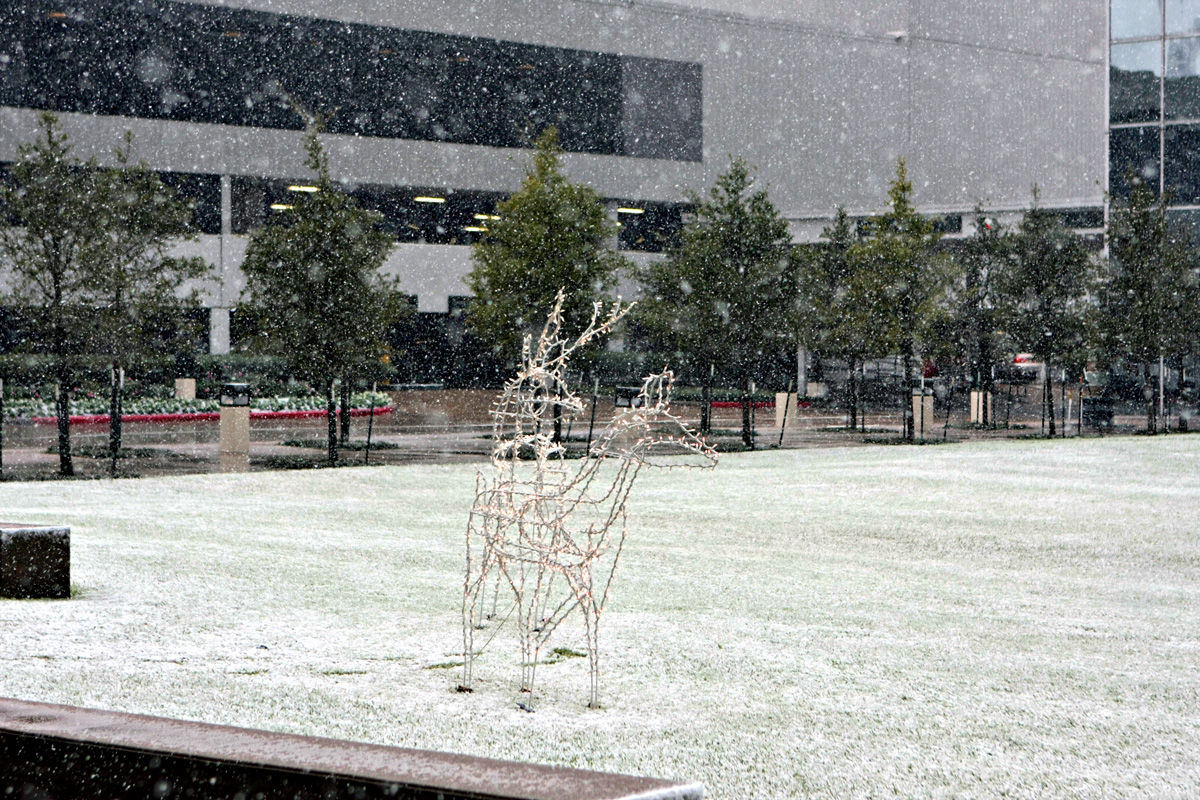
    It snowed yesterday. In Houston. Real white stuff is accumulating on the grass and rooftops. This is not normal.

    People are going crazy. Businesses and schools are closing, grown men are acting like kids on Christmas morning, and global warming skeptics are making bad jokes.

    For us, right now, snow is an amazing thing. Yet for those of you living a few hundred miles north or a few thousand miles south, snow is just part of winter life. It is not particularly exciting (at least 0.5" of accumulation isn't) or noteworthy. If anything, it can be an annoyance.

    Which brings me to my point. Blessings are relative. An event is special only in context. I am blessed not by what I receive, but by what I receive in contrast to what I was expecting.

    What are you expecting this Christmas season? Are you setting yourself up to be blessed? Or are your expectations getting in the way of your blessings?

    Merry Christmas, and Happy Snow Day to you all!

    (Photo credit to zerind)

    Thursday, December 03, 2009

    The Freedom of Ritual

    Rituals bring freedom.

    That is not a statement you hear very often. The rituals I am talking about are not centuries-old religious formalities, though. These rituals are the ones that happen every day in our lives.

    I learned this from my recent read of The Power of Full Engagement. They contrasted self-discipline with ritual. Self-discipline requires effort, rituals do not. Rituals simply happen. Brushing your teeth is a ritual. Bathing is a ritual. These are things that we (most of us) do automatically, without thinking. It takes no mental effort or energy.

    Starting an exercise program, though, requires discipline. Dieting...discipline. Starting any habit takes discipline and enormous effort, which is why it is so hard and new habits often do not stick around long.

    How to use this information, then? Stop trying to be disciplined and start building rituals. Be boring. Do the same thing, at the same time, every day. Make it a ritual, not a discipline, and the chances of it happening over the long haul go way up.

    Of course, discipline will still be required initially, but you want to get through that phase as fast as possible. And the freedom? How does boring repetetive behavior lead to freedom? Simple: when you are doing the healthy baseline behaviors that you want to do (supporting your mind, body, and spirit), then all that energy is free to be used for anything else you want.

    Rituals bring freedom. Do you buy it? Give it a try and let me know what you find.

    Wednesday, December 02, 2009

    What inspires me?


    I recently posted about inspiration and I was not quite sure what inspired me. Having thought about that question for a week or so now, I have a couple answers.


    1.  Extremity. I am inspired by people that take normal life and push it way beyond normal. Ultramarathon runners, mountain climbers, organization freaks, competitive eaters, and the like. My tendency is toward going with the flow and extreme people inspire me to push my boundaries a little bit, putting in the effort to get more out of life.
    2. Contradiction. I am also inspired by people that embody contradictions. The humble billionaire, the Christian hedonist, the boxing pacifist. These folks are similar to the extremists in that they push outside the normal, breaking the boundaries of what is considered to be acceptable. They form a new reality from combining apparently antithetical positions. Again, I am inspired to push beyond my tendency to be lazy and embrace variety and contradiction.
     (Photo credit to Lapicero)

    Tuesday, December 01, 2009

    Deliberate Use of Time

    Here's some meta-quoting for you that has me thinking. Scott Young quoting Gary Vaynerchunk responding to a reader asking how to find the time to do what you love:
    You work your 9-5, go home, spend 2 hours with the family and then crush it from 7-2. Everyone has time, just stop watching fucking Lost.
    Scott posted this a couple weeks ago, but after watching 6 straight episodes of Leverage on Netflix Saturday, I was reminded of it. I don't agree with Gary's specific time slots, but I also don't think the numbers are the point. The point is how we use our time, either deliberately or casually.

    This is not my first post on this topic, but it is something that is easy to forget. With a little less sleep, a little more efficient shower, a little less TV, and a lot more intentionality, most of us have an hour or so that we can track down every day. What if I devoted that hour, every day, to doing something meaningful?

    One hour today, seven hours this week, thirty hours this month, 350 hours this year.

    What could I build? What could I learn? Whose life could I transform?

    Leverage is a good show. But I'm not sure it's that good.

    Sunday, November 29, 2009

    The Asymmetry of Discipline

    Self-discipline turns out to be a funny thing. Discipline and lack thereof work differently, that is, their existence in one area of life has different consequences on the rest of life. They have different spheres of influence; they are asymmetrical.

    For example, when I am self-disciplined in my eating habits (not this past weekend), I must also be self-disciplined in exercise and bedtimes. Effective discipline in one makes the others slightly easier (discipline becomes easier with practice...in general), but it does not remove the need for effort and discipline. Discipline in one area does not lead automatically to discipline in others.

    On the flip side, lack of discipline in one area has a large area of influence. When I am not disciplined in my eating, it becomes easy, almost a given, that I will watch more TV, exercise less, and be more of a slacker. Lack of discipline in one area leads nearly always to lack of discipline in others.

    This is asymmetrical and frustrating. It also implies that effort spent eliminating the lack of discipline may have a larger overall payoff than efforts spent increasing specific discipline. Elimination of gluttony may be more helpful overall than strict dieting.

    Discipline is on my mind these days, so there is likely more to come later. In the meantime, does this match your experience? How do you deal with discipline (and lack thereof)?

    Friday, November 27, 2009

    Oscillation

    As we all (in the US) recover from Thanksgiving, I am thinking about oscillation. The idea of moving between two points, back and forth, in some sort of rhythm. They talk about this in The Power of Full Engagement, increasing energy reserves and strength through cycles of stress and recovery. Today we are recovering from yesterday's stress of gluttony and hopefully not repeating it too much.

    The central point in the book is that our optimum energy building comes from properly balancing stress and recovery, neither overtraining (too much stress) nor undertraining (too much recovery). It is a challenging notion, since our lives run linearly so often. At work, we work hard all day long, with barely time to eat lunch. Or perhaps we hardly work at all, doing the minimum to get by. I have done both, and they both leave me exhausted at the end of the day.

    Physically, mentally, emotionally, spiritually, we need stress, effort, and exertion to test our muscles and force more from ourselves than we thought possible. Then we need recovery to rebuild and regroup for the next effort. Too much of either one and we burn out or atrophy. The right balance and the sky is the limit.

    I tend to undertrain in most areas. How about you? How are you oscillating?

    Thursday, November 26, 2009

    Mountain Meal

    Another reprint of an old Toastmasters speech from the Storytelling manual. Happy Thanksgiving!


    I’ve celebrated Thanksgiving in many places.  There was a Denny’s in San Diego.  And that time that power went out in Seattle and my family ate by candlelight at the only open restaurant within 60 miles.  I’ve eaten Thanksgiving dinner at my in-laws, my parents, with grandparents, aunts, and uncles.  I’ve even celebrated that most American of holidays in a tiny apartment in Germany, complete with turkey and apple pie.

    But one of the most memorable Thanksgivings happened in 2002, on top of a mountain.  I had just moved away from Austin to Atlanta, and my good friend Dan and I planned a reunion backpacking trip.  We decided to meet generally half-way in Arkansas, the Ozarks.  In addition to the two of us, we also invited Mike and Jodi, who are now married, and Erin, whom I later married.  We didn’t know it at the time, but romance was in the air that trip.

    Our meeting place was at the foot of White Rock Mountain, near Fort Smith, Arkansas.  Erin and I arrived first and shivered in the dark until the other three showed up.  The night was bitterly cold, the wind was blowing, and it wasn’t long before we turned in.  It felt late, but was probably only about 7:30.  Night comes early and hard in the mountains in late November.

    While the others rolled into their tents, I looked about for a bare patch of ground.  Because you see there’s a slight complication when backpacking with 5 people…most tents are made for two.  So with Dan and Mike in one and Jodi and Erin in the other, it left me out in the cold…literally.  Fortunately, this was a time in my life when I was going a little bit crazy when it came to backpacking.  I had decided to be an ultralighter.  Ultralight backpacking is based on the idea that you should give up as much as possible…good food, comfort, warmth, whatever in order to carry as little as possible.  So to save my knees, I was carrying 3 days worth of gear and food in a 25 pound bag smaller than most school backpacks.  This included a bivy sack, essentially a waterproof liner for your sleeping bag that has all the advantages of a tent, except for the room, comfort, and aesthetics.

    But that’s enough whining.  I made it through the night, and felt like all the more of a man for it.  Thanksgiving morning dawned bright and clear, and we packed up (me in about 3 minutes, everyone else in 30) and set off down the trail.  So while millions of Americans were waking early to start the turkey, or sleeping in and dreaming of the Madden multi-legged turkey, or staking out deer blinds in the forests, we were hiking in the Ozarks, majestic views of mountain valleys clearly seen between leaf-free trees.

    That’s right, I did say deer blinds.  We were hiking at the height of deer season, so not only did we feel a little out of place wearing big backpacks, we also got to wear obnoxious orange vests.  Better that than getting mistaken for a 12-point buck, at least.

    The 6 mile hike to the top of White Rock Mountain took most of the day, and we enjoyed every bit of it, always looking forward to the feast we had planned at the end of the day.  For you see, we weren’t skipping the traditional Thanksgiving meal, we were just planning to eat it on top of the mountain.

    And eat we did.  Our main course was ham, presliced and grilled on the backpacking stove.  The meal was eaten in courses, since we only had one stove, so instant mashed potatoes were next.  Canned candied yams provided some more starch and a little sweet, and can of green beans was a nice substitute for the traditional green-bean casserole.  By this time, we were all stuffed, as is appropriate for Thanksgiving, and gazing contentedly at the rising moon.  But all this was simply the prelude for my backcountry masterpiece dessert…cheesecake.

    Thanks to modern technology, you can get just about anything in a can or a box.  There’s a mix for everything from jambalaya to brownies to pancakes to chicken alfredo.  But the one that I enjoy most is the combination of my two favorite things in the world…Jello and Cheesecake.  Jello instant cheesecake doesn’t really taste like cheesecake, but it’s not pudding or Jello or anything else, either.  But it is perfect for a backpacking dessert.  After all, it includes everything you need, and the only preparation is really to mix the powder with some water and let it chill.  Chilling was no problem on this 40 degree night, and mixing…how hard could that be?

    Well, we didn’t have an electric mixer, or even just electricity, so we had to improvise on the directions immediately.  The instructions said to mix this stuff for like 6 hours on high…tough to do.  So as a compromise, we decided on the shaking method.  We had 1-liter, wide-mouth Nalgene bottles that would hold the water and powder perfectly.  Capped off, they could be shaken as long as needed and then poured out into the tasty graham-cracker crust.  So we combined everything and set to shaking.  And shaking.  And shaking and shaking and shaking.  We each got a turn.  Finally, it looked like it was beginning to mix well and it was time to pour.  Here’s where our naivete came into sharp focus.

    The directions were to beat and pour and chill.  They assumed you’d be in your air conditioned kitchen…70, 75 degrees for the mixing and pouring, the fridge for the chilling.  We, on the other hand, managed to do our mixing in the fridge, so to speak.  So the Nalgene bottle, which had a plenty wide mouth when it came to pouring water, became a trap for our cheesecake.  Have you ever seen the traps they set for monkeys, where they put a piece of fruit in a box with a hole that’s wide enough to reach into, but when the monkey makes a fist, the hole’s too small?  The monkey won’t drop the fruit to retrieve his hand, and is easily captured.  This was kind of like that, as we struggled for the next hour to extract the maximum cheesecake-stuff from a now-tiny bottle using at best a spoon that reached halfway in.

    Needless to say, my dessert plan didn’t work quite the way I intended.  But that night, we crawled into bed, them in tents and me in my bivy sack, stuffed and satisfied, content that we had shared a Thanksgiving meal that few others had…traditional home cooking on top of a mountain.

    The remainder of the trip passed quickly.  We had beautiful scenery, we ate filling freeze-dried meals, and didn’t get shot by any of the hunters we saw.  But at the end, we ran into a site that made me stop and think.  There in the hillside, high above the road where our car was parked, was a dug-out cabin.  A natural cave had been further hollowed out and the entrance blocked in with stones to form a mountain home that was long abandoned.  And it occurred to me that the man who lived there would have thought nothing of ham and yams and mashed potatoes in the mountains.  He may have looked at us quizzically with the cheesecake, but with most of the rest, I realized that our recreation was his daily life.  I guess the world comes full-circle sometimes, and I wonder what do we do now, that 100 years from now will be for our great grand-children, their “mountain meal?”

    Tuesday, November 24, 2009

    What inspires you?

    Recently my friend Phil posted about some inspiring posters. Phil is a talented graphic designer, and it makes sense that cool posters inspire him (they're cool, but don't do the same thing for me).  What they did make me think about is what does inspire me. It turned out to be a hard question that I'm still working on.

    Most of what I read and watch educates and entertains me. Basically, I feed my mind (or numb it...I make no claim to any educational value associated with Heroes). What is missing, though, is what feeds my soul. What inspries me to reach beyond myself to something bigger, grander, better?

    It's a humbling question. Like I said, I'm still working on it. What about you? What inspires you?