Last Thursday, I left my iPad at work. I've been tablet-free for 4 days and counting now. Once I got over the shakes of the first couple days, it hasn't been that bad.
My wife has been laughing at me as I started every third sentence over the weekend with "So I've been thinking..." It turns out I think more without constant instant access to email, Netflix, Kingdom Rush, Facebook, etc. I kind of like it.
I also find myself reading more. Reading more books, that is. In the first 5 months of 2011, prior to receiving the iPad in a raffle, I read 20 books. In the last 7 months, I read 23, of which 12 were audio books in the car. The first 3 months of 2012 have seen 7 books completed, 5 in audio form. The acquisition of an amazing content delivery device (including ebooks!) destroyed my reading habit.
Seth Godin wrote about the same thing today. If I wasn't already in the midst of an iPad fast, his post might have convinced me to start. As usual, he's brief and to the point. If you read or write, follow the link.
Reading is important to me. My iPad is fun. I let the distraction of fun get in the way of my priorities. Shame on me. What do you need to take a break from?
Monday, March 26, 2012


Sunday, March 25, 2012
Bottled Energy
A manager at the grocery store this afternoon suggested that if I could bottle my kids' energy, I could put Red Bull out of business. Despite my chemistry degree, I'm not quite sure how to create something to compete directly with Thunder Muscle. But if you're interested in acquiring the energy of a 4-year-old, here are my suggestions.
- Eat well. I am far more disciplined in my kids' diets than I am in mine. Fruits, veggies, gluten-free, organic, it's all good.
- Eat less. My kids aren't picky, but they do stop eating when they're full. Good advice for anyone.
- Sleep lots. My kids get 10 - 12 hours of sleep a day. Give it a try.
- Remove stress. If you don't have to worry about bills or promotions or the meaning of life, there's plenty of energy left over to hop down the grocery aisle on one foot. And back.
- Do what you love. There are plenty of blog posts and books out there about how doing what you love brings energy. Whether that's playing the violin, being a doctor, or belting Backyardigans songs loud enough to drown out the meat department's daily specials, go for it.
Friday, December 31, 2010
2010 year in review - literary edition
Fifty.
That was the goal, and on December 26, I finished Oil by Upton Sinclair, my 50th book of 2010.
I shared this goal a while back as a way to motivate myself to keep learning. It worked. I learned, for example, about
That was the goal, and on December 26, I finished Oil by Upton Sinclair, my 50th book of 2010.
I shared this goal a while back as a way to motivate myself to keep learning. It worked. I learned, for example, about
- The 14th Century (A Distant Mirror by Barbara Tuckman)
- Running (ChiRunning by Danny Dreyer)
- Randomness (The Black Swan by Nassim Taleb)
- Lewis and Clark (Undaunted Courage by Stephen Ambrose)
- Ebola (The Hot Zone by Richard Preston)
- Leadership (Next Generation Leadership by Andy Stanley, among others)
- Philosophy (Plato and a Platypus Walk Into a Bar... by Cathcart and Klein)
- Social networking, childhood disorders, personal finance, communication, trans-racial adoption, evolving definitions of manhood, etc.
The fastest reads took only a day. The longest was about 10 months. The average, obviously, was about a week. Many of the books were in audio form, allowing me to make good use of commute time. One was on a Kindle. Most were borrowed from the library.
When I set the goal of 50 books, I wasn't sure if it was reasonable, or even possible, what with three kids and all. I'm a fast reader, though, and having the goal kept me focused on continuing to read. Like any discipline, just keeping at it is the most helpful thing.
The thing that struck me toward the end of the year, though, was how many more books I haven't read than those I have. 50 is a small number next to the 10 on my bedside table, the 87 on my library list, and the 130+ on my Amazon list. Taleb (in The Black Swan), talks about the importance of the unread books. So I'm OK with having more unread books than read ones, but for 2011, I am making more specific goals than a simple number. In the interest of public accountability, here are 2011's book goals:
- 25 books by dead people. This will force me out of my tendency to read fluffy business books and encourage a little more intensity of material. (Note that while this does allow me to count Peter Drucker and Robert Jordan, I am counting on my good faith to not abuse them for the sake of the goal.) Specifically, I'd like to include at least
- The Old and New Testaments (counts as 2 books, not 66)
- One Shakespearean play
- One classic Greek drama/tragedy/comedy
- One 19th Century British
- One Russian
- One Southern writer (I may not actually be able to stomach this)
- One famous philosopher
- One church father
- 3 books on personal finance
- 3 books on parenting
- 3 books on energy
- 3 books on marriage
- All the books currently on my nightstand
That totals to 47, though there will be some overlap between categories. The rules are the same, I have to "read" the whole book, and finish it during 2011's calendar year. Audio books are encouraged, and the Kindle will play a much bigger role now that I have one of my very own. The clock starts in 90 minutes. Game on.
This post has been pretty self-centered, and there's probably not much here for others to actually read. With a quarterly posting schedule, I don't count on many readers anyway. If you've made it this far, though, I'd love to hear what your read in 2010, what your plans are for 2011, and if you've got any recommendations for my list. Happy New Year, and happy reading.
PS - For those who are curious, the complete list in order of completion can be found here. I've put my top five recommendations in italics, though there are plenty of good ones on there (and a few I'd skip). If you'd like additional thoughts on any of them, let me know.
Wednesday, March 31, 2010
Spiritual Constipation
The human digestive system works on a simple principle. Food goes in, waste goes out. Along the way, the body is nourished. Sometimes, though, something goes wrong and constipation results. Food goes in, nothing comes out. Along the way, the body hurts. Pain is a clear signal of malfunction.
The human spirit works on a similar principle. Food goes in, fruit goes out. Along the way, the spirit is nourished. Sometimes, though, something goes wrong and spiritual constipation results. Food goes in, nothing comes out. Along the way, the spirit hurts, but the signal it sends is more subtle than physical pain...(more)
This article was written for Lucid Magazine. Click here to read the rest of it and check out the other cool stuff.
Thursday, March 25, 2010
How are you learning?
50 books.
That's my reading goal for 2010. In addition to blogs, magazines, and whatever else, my goal is to read 50 books by year-end. No limits on the genre, length, or quality...just 50 books. With 13 to date in the 1st quarter, I'm on track.
I have chosen this goal because books open up new worlds to me. New ideas, new facts, new ways of thinking; they all come to me through books. I read for entertainment, but above all, I read to learn. Learning leads to growth, and without growth, there is only decay. So despite all the demands on my time, I read.
The point of this post is not, however, to impress you with my reading goal (many people read more). Nor is it to encourage you to read more (though I think that's always a good idea). Rather, it is a question of learning. Specifically,
How are you learning?
If not through books, what? How? Are you listening to Open University courses? Online training sessions? Attending lectures? Blogs, magazines, newspapers?
Life keeps moving. The only way to keep up is to grow, and without learning, there is no growth. How are you keeping up? How are you learning?
(That last question is not rhetorical. I know how I'm learning, and I'm curious...how are you learning?)
Sunday, February 14, 2010
On Connection
In the age of the internet, connectivity is everywhere. There are hundreds of apps and websites all seeking to connect us with others. It seems, as well, that this is something we desire. If we didn't care about connection, Web 2.0 would never have begun, let alone thrived. Yet, is there a limit? Can we be too connected?
There is only one way to find out (for an engineer). Derive the equation for the system and see if there is a maximum. Pretty easy, except that we are dealing with humans, not atoms, so there will have to be some approximation. So, simplifying it down, I propose the Connection Index (CI).
As a result of man's aversion to complexity, we are therefore drawn to the simple factor: number of connections. We know that a single connection makes us feel good, so we strive to increase the number of connections, knowing that more connections leads to greater CI (assuming constant quality). Since we are ignoring quality because it is too complex, we might as well assume it is constant. So we have more Twitter followers, more Facebook friends, and more LinkedIn connections, each one linearly increasing our CI...right?
Clearly, this logic breaks down. A short pause is all it takes to realize that my 350th friend on Facebook does not have the same quality of connection that I do with my wife (at least, they better not). So if the average quality of each connection is not the same, our assumption of constant average quality may not be as valid as we would like to think.
Imagine, for example that you have one connection with your soul mate. Your best friend in the entire world. One connection times a very high average quality equals a high CI. Now add another connection of an old classmate whom you have not seen in 15 years (a common Facebook occurrence). Very little connection quality, dragging the average quality of connections down significantly. But the number doubled, so the overall CI likely went up a bit, since the connection with your soul mate is unaffected by this new Facebook friend. So far, so good...Facebook has increased our CI.
Continue the thought experiment for a while, now. More and more people friend you on Facebook. One introduces you to Twitter and mentions LinkedIn. MySpace looks interesting, as does Tumblr. Google throws in Wave and Buzz. Connections (and the platforms that facilitate them) are multiplying rapidly. Which is good, since more connections leads to greater CI...right?
This is where it gets sticky. All those connections are clamoring for time and attention. On Facebook, your spouse gets equal screen time with your college roommates who compete with your clients on LinkedIn. Simply having a connection requires something of you, and that something has to come from somewhere. That somewhere will eventually be from the time and attention spent on your soul mate, that first and strongest connection. At first, that is no big deal. But soon, a loss of time will lead to a loss of quality in that connection, and CI begins to drop.
By this reasoning, at some point, additional connections begin to reduce the average quality more than can be compensated by the added connection. CI starts dropping, and will continue to drop with more connections, likely accelerating as we try to compensate for the negative feeling of a lower CI with a greater number of connections. (Remember our focus on the easy part of the equation? Plus, it worked up until now, right?)
So where does that leave us? In an ever downward spiral of reaching for something that is fleeing from us faster than we can pursue it. Once CI begins to drop, the only way to stop the bleeding is to defy instinct and stop. Don't add more friends, don't join another network, just stop.
Then focus on the other half of the equation. Rather than increasing numbers, increase the quality. Spend more time with your spouse, face-to-face with friends. Invest in the connections you have, and maybe even cut off some of those that are wasting your time.
The index is what matters. Stop stressing quantity and make the quality happen.
There is only one way to find out (for an engineer). Derive the equation for the system and see if there is a maximum. Pretty easy, except that we are dealing with humans, not atoms, so there will have to be some approximation. So, simplifying it down, I propose the Connection Index (CI).
Connection Index = number of connections * average quality of each connection
I also propose that each of us desires to maximize our CI. Since the equation is straightforward, maximization of CI involves increasing the number of connections and/or their quality. It gets complicated when we consider that one of those factors is easy to both influence and measure, while the other is not.
As a result of man's aversion to complexity, we are therefore drawn to the simple factor: number of connections. We know that a single connection makes us feel good, so we strive to increase the number of connections, knowing that more connections leads to greater CI (assuming constant quality). Since we are ignoring quality because it is too complex, we might as well assume it is constant. So we have more Twitter followers, more Facebook friends, and more LinkedIn connections, each one linearly increasing our CI...right?
Clearly, this logic breaks down. A short pause is all it takes to realize that my 350th friend on Facebook does not have the same quality of connection that I do with my wife (at least, they better not). So if the average quality of each connection is not the same, our assumption of constant average quality may not be as valid as we would like to think.
Imagine, for example that you have one connection with your soul mate. Your best friend in the entire world. One connection times a very high average quality equals a high CI. Now add another connection of an old classmate whom you have not seen in 15 years (a common Facebook occurrence). Very little connection quality, dragging the average quality of connections down significantly. But the number doubled, so the overall CI likely went up a bit, since the connection with your soul mate is unaffected by this new Facebook friend. So far, so good...Facebook has increased our CI.
Continue the thought experiment for a while, now. More and more people friend you on Facebook. One introduces you to Twitter and mentions LinkedIn. MySpace looks interesting, as does Tumblr. Google throws in Wave and Buzz. Connections (and the platforms that facilitate them) are multiplying rapidly. Which is good, since more connections leads to greater CI...right?
This is where it gets sticky. All those connections are clamoring for time and attention. On Facebook, your spouse gets equal screen time with your college roommates who compete with your clients on LinkedIn. Simply having a connection requires something of you, and that something has to come from somewhere. That somewhere will eventually be from the time and attention spent on your soul mate, that first and strongest connection. At first, that is no big deal. But soon, a loss of time will lead to a loss of quality in that connection, and CI begins to drop.
By this reasoning, at some point, additional connections begin to reduce the average quality more than can be compensated by the added connection. CI starts dropping, and will continue to drop with more connections, likely accelerating as we try to compensate for the negative feeling of a lower CI with a greater number of connections. (Remember our focus on the easy part of the equation? Plus, it worked up until now, right?)
So where does that leave us? In an ever downward spiral of reaching for something that is fleeing from us faster than we can pursue it. Once CI begins to drop, the only way to stop the bleeding is to defy instinct and stop. Don't add more friends, don't join another network, just stop.
Then focus on the other half of the equation. Rather than increasing numbers, increase the quality. Spend more time with your spouse, face-to-face with friends. Invest in the connections you have, and maybe even cut off some of those that are wasting your time.
The index is what matters. Stop stressing quantity and make the quality happen.
Sunday, January 17, 2010
Today, Haiti, Tomorrow...Haiti?

According to the CIA World Factbook, Haiti's per capita income is $1,300 annually, ranking it 203rd in the world (out of 229). Inflation is 15.5% (194th highest in the world) and unemployment is not even reported as a number, rather as "widespread unemployment and underemployment; more than two-thirds of the labor force do not have formal jobs." These numbers are from well before the recent earthquake.
A tremendous amount of aid will pour into the country over the next few months. After that, our memories will fade, the money will dry up, and then what? Will more than half of Haitians finally be employed? Not likely. Recovery from disaster is hard...recovery from endemic poverty is nearly impossible.
So I want to challenge you to join me and my family in making a commitment that goes beyond a text message. For the past four years, we have been sponsoring Robendy through Compassion International. Robendy lives in Haiti and happens to have been born exactly 8 years to the day before our twins. He lives on the side of the island away from the worst of the damage, but beyond that, we know no more than you do about his current fate. He was our first thought on hearing about the earthquake.
Sponsorship is different than giving to disaster relief. Instead of a chunk of cash now, sponsorship is spread out over time, a steady drip of help to those in need. It keeps us engaged, and though the contributions are automated, we are constantly reminded through letters, updates, and bank statements that we are involved, every day, in what happens in Haiti.
Compassion is not the only organization that has a sponsorship model. Haiti is not the only country in the world with poverty. So I don't really care if you give through Compassion, and I don't particularly care if you give to Haiti. I do care that you make a commitment beyond the headlines. Haiti will need us next year, just like they did last year. Will you be there?
Click here to access Compassion International's sponsorship page.
Click here to access Compassion International's Haitian disaster relief page.
PS - I did no research into other organizations for this post. If you have one you would recommend, please mention it in the comments. Also, if you have a sponsorship story, I would love to hear it.
(Photo credit to Compassion International)
Friday, January 08, 2010
Grand Adventures in Fatherhood

Then my 18-month-old son wakes up crying. He wakes up his twin sister, and they start a chorus. So I climb out of bed, fill sippy cups with milk, and try to wake up before their 2.5-year-old brother gets out of bed. Soon enough, the volume level in the house increases ten-fold and I am reading Who Says Woof for the 10th time in a row while dreams of grand adventures fade quickly into the background.
Daily life with three kids under three can quickly become monotonous. They fight...again. They make up and play sweetly together...again. They yell, they eat, they throw food, they throw toys, we read board books...again. The dreams of a grand adventure grow bigger while the reality seems further and further away.
But does it have to be this way? Is fatherhood incompatible with the grand adventures of life? Of course not. Grand adventures are there, they just take a little more work. Here's how to make them happen.
- No excuses.
When my second and third kids were born, my wife and I made a commitment that our kids would not be an excuse. Having toddlers does not excuse me from exercising, reading, blogging, traveling, or anything else. Never use your kids as an excuse to withdraw from the world or to postpone your dreams. By making excuses, we make our kids responsible for our lives, and it's not their problem. You are still the one responsible for you, and having kids does not change that. - Get real.
At the same time, we're responsible for them now, too. We have to be honest. Do you know who you are, who your wife is, who your kids are? Do you know energy levels, abilities to endure change, or physical requirements? Having three kids is different than having one. Having a 2-year-old is different than having a 12-year-old. A child with Down's Syndrome has different challenges than one with autism. You have to know the real boundaries in your life. - Keep dreaming.
The one thing that kids never do is prevent us from dreaming. In fact, they can expand the dreams. Now I not only dream of running a marathon, I dream of running a marathon with a triple-stroller. I dream not just of re-learning to play the piano, but of playing a duet with my son. Keep dreaming and imagining the greatest life possible for you and your family. - Focus.
Dreams are fun. Dreams lived out are even more fun. The trouble is, even without kids, trying to live all our dreams is a recipe for frustration. There is simply not enough time/money/energy to do them all. So focus. Pick one that you will commit to making happen. By taking the dreams one at a time, you can bring everything you have to bear on it and make it happen.
- Be creative.
Once you have the dream and a realistic view of the world, it's time to get creative. How can they fit together? How can you find time to read? Where will the money for plane tickets come from? How can you build that sleigh bed without risking your 3-year-old's fingers in the table saw? You have defined a problem clearly and have committed to not making excuses. There is a solution. It just requires some creativity to find it.
- Recruit help.
If you can achieve your dream on your own, then it's not a very big one. Small dreams are fine, but if you're dreaming big, you're going to need some help. The first person to recruit is your wife. If she isn't on your side, there are other blogs you should be reading. If your kids are old enough, recruit them. Look for other dads, in real life and online. Look for people who can support you physically (babysitting), emotionally (encouraging your dream), and mentally (helping brainstorm solutions). If you go it alone, you will likely fail. If you recruit help, you increase the chances of living the dream, and strengthen relationships along the way. - Go.
The last step is the hardest. You just have to do it. You have to buy the tickets, leave the house, and get on the plane with all three kids. All the dreaming and planning is meaningless until you go, take action, and live the dream.
Finally, there is a mental shift that happens. Men, in particular, are wired for big things, action things. We want to build, move, take action and have an impact. Our dreams tend in those directions. Fatherhood changes the game a little, though. Rocking a newborn to sleep at 3 in the morning is not bold. Listening to a 6-year-old's piano recital is not dramatic. Picking a 12-year-old up from school does not make the news.
This is where the shift happens, though. My son's excitement to see the elephant's bath at the zoo, my daughter's squealing when I come home after work, or my kids spontaneously saying "I love you" does things in my heart that no other dream can ever do. Fatherhood is the grandest of grand adventures. As you take action to make your other dreams happen, remember that simply being "Dad" is the greatest dream of all.
Now go and live it.
(Photo credit to jbrindes)
Thursday, December 31, 2009
The End (of 2009)
Between 10/19/06 and 8/24/09, I wrote six posts for this blog. I officially relaunched on 8/25/09 and have since written over twenty times that number, with this post being number 130. My reason for blogging is to help refine my thinking, and to give myself an outlet for all the input that I am inclined to gather. Since output is not natural for me, I decided to follow Seth's lead (in posting rate, not quality of content) and require daily posts through the end of the year. The end has now come.
I learned through the process that there is a lot to write about. Ideas were never a problem. I also learned that writing every day is good for me. It is enjoyable, and has succeeded in forcing me to think. However, it turns out that while writing every day is good, publishing every day is a little much. There were a few good posts, a few bad ones, and a lot of middling ones. The pace eliminated much possibility of editing, and first drafts generally are not that good. That is the nature of writing, but there is no need for me to subject you to it.
So going forward I will no longer require daily posting of myself. It is a bit of a relief. We'll have to see what actually happens. (Note that there is no implication that the quality will increase when quantity diminishes.)
Enough about me, what about you? While I write primarily for myself, I appreciate readers as well. Are you deriving any value? Does it matter to you whether I continue writing or not? If so, are there topics that you would like to see more or less of? Leave a comment and let me know.
So that closes out 2009. Happy New Year, celebrate wildly, drive safely, and I'll see you on the other side.
Wednesday, December 30, 2009
Best books of 2009
As 2009 draws to a close, I thought I would look back at the books I have read this year. My reading tends to cover a pretty broad range, so instead of picking a single set of "best" books, I will give the award in several categories. To be on this list, the book must meet two criteria:
Born to Run by Christopher McDougall
I wrote about a lack of inspiration before reading this book. I then read it and was inspired. McDougall tells the story of a tribe of Native Americans who run. A lot. He talks about humanity's prehistoric running and the possibility that we (Homo Sapiens) out-competed the Neanderthals because we were better distance runners. Most amazingly, he describes a persistence hunt, where African bushmen literally run an antelope to death. It made me want to run a marathon, and no book (or anything else) has ever done that before.
Best Book for Learning What Everyone Should Know
Basic Economics by Thomas Friedman
Most of what I have to say about Friedman's book, I have already said. I tweeted at one point that no one should be allowed to have an opinion about anything until they have read this book. That stance is a little strong, but it is a decent place to start. Life involves trade-offs, and economics is the science of those trade-offs. If you do not have a basic grasp of those, the reality of the world will smack down anything you attempt. Everyone should already know this stuff, but very few people talk like they do. Don't be in the majority on this one.
Best Book for Reading about Writing
On Writing by Stephen King
I have never read any of King's fiction, and do not really plan to. His genre does not appeal to me, but his philosophy of writing is well written. He says little that others have not said, but he says it as well as anyone. Read a lot, write what you care about, and write a lot. He probably implies a greater likelihood of success than is really out there, but otherwise he is dead on. It applies to most of life, too. Work hard at what you care about, and the rest will follow.
Best Book for Rethinking Education
Weapons of Mass Instruction by John Taylor Gatto
I posted a couple snarky items inspired by this book (here and here). I cannot say I am particularly proud of them, but the book's immediate effect was to really get me down on institutional schooling (including, but not limited to, public schools). As a product of America's public school system, the book made me feel shortchanged. Gatto is an evangelist, and preaches hard. The reason to read this book is not, however, to pull your kids out of public school and join a commune. The book forces us to think about things that we normally do not, but are very important. What is education? Why do we go to school? Why bother learning at all? What should we learn? No matter what education decisions you make for your kids, you owe it to them to make the decisions consciously, and this book will not let you do otherwise.
Best Cookbook
The Breath of a Wok by Grace Young and Alan Richardson
My family gave me a wok for my birthday earlier this year, which I had wanted for a while. This book came from the library to train me in the art of wok cooking. A random selection that was a wonderful experience to read and cook from. I posted about it here, and of all the wok-books I have read, it still remains the most inspiring and useful.
Best Books for Dads
Strong Fathers, Strong Daughters by Meg Meeker and The Way of the Wild Heart by John Eldredge
Since I have had kids, I have tried to channel some of my reading into learning about being the dad they deserve. I have a long ways to go. I am learning, though. I have both sons and a daughter, so I read books this year covering both of them. I described Meeker's book earlier. Eldredge's book is both for fathers and men in general, following up on his earlier Wild at Heart. This one goes into detail about the stages of the masculine journey and how we can lead our sons (and ourselves) through them. The translation of Eldredge's ideas from his (apparently) idyllic Colorado mountain ranch to the suburbs of Houston is always difficult for me, but the effort is worthwhile. Intentionality in raising our kids is always better than simply going with the flow.
Best Book by Dad
Spycraft by Robert Wallace and Keith Melton
My dad has written three books, and Spycraft is the best of them (though I have only started the third). It tells the story of the Office of Technical Services (OTS), the CIA's gadget-geeks, from the 1940's to the 1990's. Operations are described with a focus on the cool gear, making much of the book read like a James Bond film told by Q. The Cuban prison chapter is worth the price of the book on its own. Plus, if you're looking for an autographed copy, I can probably arrange something.
Best Book to Make You Stop Reading This Blog
The Tyranny of Email by John Freeman
The final book in the list, and one of the last books I read this year (it was a Christmas gift), may have the least literary value, but the biggest impact on my day-to-day life. It is a call to slow down communication and unplug from the internet just a little bit. I wrote more about it here, and some of the other thoughts it raised here and here.
In the end, I hope you do not stop reading my blog. If you do, though, I hope it is to make time for books like these. Books open the world in a way blogs and Twitter and cable news never can, and we all need more of them in our lives. Read. A lot. And let me know what your best books of 2009 were. I'm always looking for ideas.
- I must have read (or listened to, in the case of audiobooks) the book in its entirety, and completed it in the 2009 calendar year. I am in the middle of a couple right now that would make the list if I were to finish them before December 31. I won't, though, so they can go on next year's list. This limits the candidate pool to about 35 books.
- The book must be worth reading. By using categories, I could easily recommend everything ("Best Book to Read After All Quality Literature is Confiscated"), but I won't. If it is on this list, it won't waste your time.
Born to Run by Christopher McDougall
I wrote about a lack of inspiration before reading this book. I then read it and was inspired. McDougall tells the story of a tribe of Native Americans who run. A lot. He talks about humanity's prehistoric running and the possibility that we (Homo Sapiens) out-competed the Neanderthals because we were better distance runners. Most amazingly, he describes a persistence hunt, where African bushmen literally run an antelope to death. It made me want to run a marathon, and no book (or anything else) has ever done that before.
Best Book for Learning What Everyone Should Know
Basic Economics by Thomas Friedman
Most of what I have to say about Friedman's book, I have already said. I tweeted at one point that no one should be allowed to have an opinion about anything until they have read this book. That stance is a little strong, but it is a decent place to start. Life involves trade-offs, and economics is the science of those trade-offs. If you do not have a basic grasp of those, the reality of the world will smack down anything you attempt. Everyone should already know this stuff, but very few people talk like they do. Don't be in the majority on this one.
Best Book for Reading about Writing
On Writing by Stephen King
I have never read any of King's fiction, and do not really plan to. His genre does not appeal to me, but his philosophy of writing is well written. He says little that others have not said, but he says it as well as anyone. Read a lot, write what you care about, and write a lot. He probably implies a greater likelihood of success than is really out there, but otherwise he is dead on. It applies to most of life, too. Work hard at what you care about, and the rest will follow.
Best Book for Rethinking Education
Weapons of Mass Instruction by John Taylor Gatto
I posted a couple snarky items inspired by this book (here and here). I cannot say I am particularly proud of them, but the book's immediate effect was to really get me down on institutional schooling (including, but not limited to, public schools). As a product of America's public school system, the book made me feel shortchanged. Gatto is an evangelist, and preaches hard. The reason to read this book is not, however, to pull your kids out of public school and join a commune. The book forces us to think about things that we normally do not, but are very important. What is education? Why do we go to school? Why bother learning at all? What should we learn? No matter what education decisions you make for your kids, you owe it to them to make the decisions consciously, and this book will not let you do otherwise.
Best Cookbook
The Breath of a Wok by Grace Young and Alan Richardson
My family gave me a wok for my birthday earlier this year, which I had wanted for a while. This book came from the library to train me in the art of wok cooking. A random selection that was a wonderful experience to read and cook from. I posted about it here, and of all the wok-books I have read, it still remains the most inspiring and useful.
Best Books for Dads
Strong Fathers, Strong Daughters by Meg Meeker and The Way of the Wild Heart by John Eldredge
Since I have had kids, I have tried to channel some of my reading into learning about being the dad they deserve. I have a long ways to go. I am learning, though. I have both sons and a daughter, so I read books this year covering both of them. I described Meeker's book earlier. Eldredge's book is both for fathers and men in general, following up on his earlier Wild at Heart. This one goes into detail about the stages of the masculine journey and how we can lead our sons (and ourselves) through them. The translation of Eldredge's ideas from his (apparently) idyllic Colorado mountain ranch to the suburbs of Houston is always difficult for me, but the effort is worthwhile. Intentionality in raising our kids is always better than simply going with the flow.
Best Book by Dad
Spycraft by Robert Wallace and Keith Melton
My dad has written three books, and Spycraft is the best of them (though I have only started the third). It tells the story of the Office of Technical Services (OTS), the CIA's gadget-geeks, from the 1940's to the 1990's. Operations are described with a focus on the cool gear, making much of the book read like a James Bond film told by Q. The Cuban prison chapter is worth the price of the book on its own. Plus, if you're looking for an autographed copy, I can probably arrange something.
Best Book to Make You Stop Reading This Blog
The Tyranny of Email by John Freeman
The final book in the list, and one of the last books I read this year (it was a Christmas gift), may have the least literary value, but the biggest impact on my day-to-day life. It is a call to slow down communication and unplug from the internet just a little bit. I wrote more about it here, and some of the other thoughts it raised here and here.
In the end, I hope you do not stop reading my blog. If you do, though, I hope it is to make time for books like these. Books open the world in a way blogs and Twitter and cable news never can, and we all need more of them in our lives. Read. A lot. And let me know what your best books of 2009 were. I'm always looking for ideas.
Tuesday, December 29, 2009
Manly Men and Womanly Women
I recently discovered The Art of Manliness. The blog is focused on recapturing more traditional roles and characteristics of men, without reverting to any 1950's chauvanistic stereotypes. It has been interesting to read, since the only folks that I had heard about previously trying to clarify gender roles in any traditional manner have been evangelical Christians. This blog appears to have little or no religious leaning at all.
An article that caught my eye recently was titled "What can manly men expect of women?" There was not much of an answer in there, mostly just the question. There may be some interesting responses in the comments, but I have not gone back to read those yet. Here I have nothing new to add other than to reiterate the question in a slightly different way. What does the female equivalent of a manly man look like? Who is a womanly woman today?
The easy answer for some is to quote Proverbs 31. That's fine, but I suspect that doesn't work easily for all women. Just like my manliness is no longer defined by my ability to shoot a deer or trap a rabbit for dinner, making your family's clothes no longer seems like a useful yardstick for womanliness.
I have no answer to this, given my lack of study and/or experience being a woman. With my 18 month old daughter sitting in my lap right now, though, it seems a useful topic to learn more about. So I would love to hear your thoughts. What does it mean to be a womanly woman in the 21st century?
Monday, December 28, 2009
The Tyranny of Email
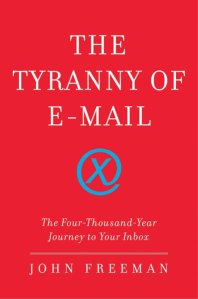
Summary: The communication patterns resulting from internet connectivity (primarily represented by email) are unlike anything humans have ever encountered before, and they are killing us.
That message is not particularly novel, complaints about email are nearly as ubiquitous as email itself. Nor is the last chapter of advice for dealing with it anything that has not been written on productivity blogs for years. That said, you should read it.
The core of the book traces the development of communication, primarily examining the speed with which we have been able to exchange information. Freeman writes well, making the story interesting and engaging. Most importantly, it puts the last 15 years of the internet into a little bit of context, which is an angle I have not read elsewhere.
As a result, the call for slowing down communication at the end has greater weight than that from a techno-phobe or productivity guru. In light of how we are wired, constant, rapid-fire communication appears to have no benefit and plenty of detriments to our social and psychological well-being.
Read the book, slow down, and talk to someone without a keyboard.
Sunday, December 27, 2009
Real-life Friends
Most of us have a lot of friends. We know a lot of people by their first names, we know a lot about what is happening in a lot of others' lives. Most of those people, though, we rarely see face-to-face. Kind of ironic that they call the thing "Face"book, huh?
Following up on yesterday's post, I am thinking about the relationships behind the news. The prevalence of news relies on rapid dissemination, which means the written word broadcast over the internet. Nothing else packs as much factual information into the short time we have to consume it. So as we are innundated with news, it becomes a requirement that we spend more time on reading written stuff (with occasional pictures) than on talking and listening.
Scott (see, I know him by his first name!) posted recently about how friendships are formed. He argues that shared experiences trump shared values every time. Most college roommates and comrades-in-arms would agree. While he uses an online example to show this, I think it is a rare thing for an experience to be shared with someone in another room or country, even in today's connected world.
So in this new Web 2.0 world of social media, who are your real friends? Who have you had dinner with lately, or trusted to watch your kids? Who sees your tears and hears your laughter? Who shares your life beyond consuming your broadcasts?
Our real friends are not our Twitter followers and Facebook friends (though overlap is certainly possible). We all acknowledge this intellectually, but do we embrace it really? Do we spend as much time cultivating even just one real friendship as we do a hundred or a thousand virtual ones? To put a blunt point on it, when it hits the fan, who will visit the hospital, look after your kids, bring you a meal, or just tell you the truth you don't want to hear?
As we enjoy the amazing awesomeness that is the Internet, let us not lose sight of real life. For what good is it for a man to gain the whole world wide web, yet forfeit his real soul?
Saturday, December 26, 2009
News Gluttony
Reading through a Christmas gift, I came upon the story of the second telegram sent by Samuel Morse, "HAVE YOU ANY NEWS?" It (along with the rest of the book) has me thinking about the nature of news.
We seem to be wired for news. Stories of the past often involve isolated towns or homes eagerly awaiting letters or visitors or messengers bringing news. In general, news is something that comes from outside, something that we have not personally been a part of. My birthday party is not news to me, but yours (which I was unable to attend) is.
For most of human history, news was a rare thing. We got news only occasionally, and it was a treat, like a special dessert on holidays. The balance between our own experience (non-news) and that of others (news) was decidedly on the side of non-news.
Today, all this has changed. Thanks to the internet, news is everywhere. Nearly by definition, the internet is all news. Every email I receive, every blog I read, every Facebook album I browse is someone else's experience, that is, news to me. We are awash with news and are compelled to generate it ourselves, sending email and posting to blogs, Facebook, Twitter, and forums. The balance of our lives has shifted, significantly, away from non-news.
So I wonder, can we handle it? Our tendency to crave fat and sugar has gone from a benefit in a lean agricultural economy to a detriment in the land of buffets and drive-thrus. Is our craving for news any different? Does the constant stream of news help us live better lives? Or is it contributing to mental gluttony with effects we cannot foresee (health impacts of extra weight have only recently been determined, after all)? Is one of those effects the erosion of the non-news part of our lives, the part that we are actually experiencing, not just reading about?
I am not the first to ask this question. This is the first time I have phrased it to myself in this way, though. It is making me think. How about you?
Friday, December 25, 2009
A Country Christmas
Another holiday, another old Toastmasters speech. Reading this now brings mixed emotions as my family celebrates our first Christmas since Grandma's death. This was always her favorite holiday. While we miss her, she would never want us to hold back the celebration. So Merry Christmas to all, and to all a Good Night!
The air was frigid. Not bitter, but bracing, refreshing. I lay on my back looking up at the stars, amazed at their clarity, each one a blazing fire, but somehow the heat was left behind as the light traveled across the vastness of space to meet me in the middle of nowhere. OK, it wasn’t exactly the middle of nowhere, but it was real close, the middle of Kansas; Barnard, Kansas to be specific. My grandfather was born there, my dad was born there, my uncle still lives there, and for me, that little town of 103 is Christmas.
As I lay there, a 10-year old boy amazed by stars unseen in the city, Christmas Eve festivities were ongoing inside. We were, as always, at the old homestead, the home my great-grandfather built over a century ago. In it he and his wife raised 7 burly boys and one very tough girl, most of who carried on the family tradition of farming the fertile Kansas fields. My grandfather was the eldest of those 8, and at the time I was stargazing, he was the patriarch of the brood. Inside, he would have been occupying the recliner of honor overseeing the celebration.
The house was never actually big enough for the original 10 residents, let alone the 60 that were bursting from the seams that evening. Three or four generations of Wallaces celebrate in that house every year, and though some pass on or move away, others enter by birth or marriage. The house is always warm, almost claustrophobic, but with a palpable aura of love and family that I experience nowhere else.
Thinking back, it’s not hard to recall the menu that night, because it’s always been the same. Two or three of the women bustle about in the kitchen, serving hot chili and potato soup that warms both body and soul. While you’re there, you can pick up some iced tea (unsweetened in the Midwest), lemonade, or water. Coffee is available later on in the evening. Turkey and ham sandwiches are made with rolls so white and soft that they hardly require chewing, and the whole thing is held together by dollops of full-fat mayonnaise. Grandma always supplies the bottomless popcorn tin, a family favorite that is always begun, but never seems to get finished. Debra can be relied on to supply “shorty”, a family recipe that somehow manages to produce a bread-like food from nearly pure lard. Although traditionally always requested, you can count on seeing it again at dinner Christmas day. And long before Jello Jigglers, finger Jello was a staple, red and green translucent cubes that slide down your throat as fast as you’re willing to consume them. Innumerable cookies, crackers, cheese and the ever-present sweet pickles round out the informal meal.
Later in the evening, when everyone has eaten their full and the soup ladles scrape bottom; I would be back inside for the carols. In a family with 42 first cousins, several managed to achieve musical talent, and one leads us on the piano as careworn carol sheets are found and passed around. Everyone is encouraged to pick their favorites to sing, although those under the age of 10 seem to have inordinate influence on the song selection.
Sometime during the singing, you can count on Santa Claus appearing, riding in from the night in his Mercury Cougar sled. His pillow-gut and polyester beard are not always in the best of shape, but everyone looks forward to his visit and the candy he carries. It doesn’t matter if you’re 8 or 80, he’s sure to encourage general good behavior and scold the bad (and he seems to find particular delight scolding those older than him). With a final Merry Christmas and a ho, ho, ho, he departs, off to destinations unknown.
When the night is over, we say our goodbyes and return to grandma’s house, and attempt to sleep before the big Christmas morning. For now, however, I was content to look at the stars, blazing balls that appear so tiny and bright. For a city boy, the clear nights of the country are an uncommon and awe-inspiring sight. But the true brightness, and what draws me back each year, is what was inside; the love of my family, the warmth of tradition, and the simple down-home comfort of a true country Christmas.
Thursday, December 24, 2009
The Tipping Point of Faith
I have recently been enjoying an Open Yale course on game theory. The professor is entertaining and the subject fascinating. The last several lectures have been covering Nash Equilibria , those states of a game where no player can gain an advantage by changing their strategy or choice. This concept can help in understanding the best responses for each player and where the end state of a game could end up. An extension of the idea is that where two equilibria exist in a game, there may be a tipping point where different equilibria are favored depending on which side you are on.
As a geographic analogy, consider the Continental Divide. It is the tipping point in directing water in North America. Rain falling to the east ends up in the equilibrium known as the Atlantic, and rain to the west ends up in the Pacific.
As I was listening to this, it occurred to me that Nash Equilibrium could be a good description of something I have experienced and witnessed in the area of spirituality and faith. I think that the payoff for any given belief system could be crudely modeled like the following graph.

The scale runs from no belief on the left to complete belief on the right, with shades of belief in between. The vertical axis is the pay-off in terms of contentment, joy, happiness, peace, whatever.
At the far left, a non-believer is at peace with their decision. They operate free of the obligations and rewards of the belief system, choosing to do what works for them (possibly a different faith) and are therefore happy with life.
At the far right, a true believer is at peace with their decision. They are comfortable within the structure of the belief system, are privy to the rewards (community, eternal confidence, etc.) and are therefore happy with life.
In between are most people. Taking the evangelical Christian system as an example, these are the folks who claim belief in God, but never show up for church. Or the people who are in church but asleep. Or who open their Bibles only during Sunday school. Or who display an unopened Bible prominently on their coffee table. All of these folks are riding the fence in one way or another.
To bring back the Game Theory, the Nash Equilibria are, of course, on either extreme. The payoff is maximized at full belief or full non-belief. A rational player (one who is looking to maximize payoff) will always be forced to one side or the other, though the theory does not make any claim as to which side is preferred.
Faith is not generally amenable to mathematical analysis or simplified Game Theory. So clearly this does not tell the whole story. It does, however, remind us of something that gets easily hidden in the bustle of everyday life. Is our faith real? And if it is not, should we keep playing games? Are we happy in the middle, or does something need to change?
I would love to hear your where you stand on the questions or the theory. Leave a comment and let me know what you're thinking.
(picture credit to R. Brown)
As a geographic analogy, consider the Continental Divide. It is the tipping point in directing water in North America. Rain falling to the east ends up in the equilibrium known as the Atlantic, and rain to the west ends up in the Pacific.
As I was listening to this, it occurred to me that Nash Equilibrium could be a good description of something I have experienced and witnessed in the area of spirituality and faith. I think that the payoff for any given belief system could be crudely modeled like the following graph.

At the far left, a non-believer is at peace with their decision. They operate free of the obligations and rewards of the belief system, choosing to do what works for them (possibly a different faith) and are therefore happy with life.
At the far right, a true believer is at peace with their decision. They are comfortable within the structure of the belief system, are privy to the rewards (community, eternal confidence, etc.) and are therefore happy with life.
In between are most people. Taking the evangelical Christian system as an example, these are the folks who claim belief in God, but never show up for church. Or the people who are in church but asleep. Or who open their Bibles only during Sunday school. Or who display an unopened Bible prominently on their coffee table. All of these folks are riding the fence in one way or another.
To bring back the Game Theory, the Nash Equilibria are, of course, on either extreme. The payoff is maximized at full belief or full non-belief. A rational player (one who is looking to maximize payoff) will always be forced to one side or the other, though the theory does not make any claim as to which side is preferred.
Faith is not generally amenable to mathematical analysis or simplified Game Theory. So clearly this does not tell the whole story. It does, however, remind us of something that gets easily hidden in the bustle of everyday life. Is our faith real? And if it is not, should we keep playing games? Are we happy in the middle, or does something need to change?
I would love to hear your where you stand on the questions or the theory. Leave a comment and let me know what you're thinking.
(picture credit to R. Brown)
Wednesday, December 23, 2009
Conversion of a group class skeptic

- Skepticism - "Group classes...whatever. I prefer working out alone."
- Curiosity - "I wonder what they're doing in there..."
- Trial - "He said it was pretty good...I'll check it out tomorrow."
- Arrogance - "Crunches? That's it? I'll show them how it's done."
- Exhaustion - "Pant...pant...pant...wheeze."
- Denial - "Two more sets?!? Are you serious?"
- Collapse - "..."
- Pain - "Captain's log, T+3 days. Able to get out of bed without groaning this morning. Hoping to be able to stand upright tomorrow."
- Conversion - "See you next week!"
(Photo credit to Urban Active Fitness)
Tuesday, December 22, 2009
I will teach you to be rich
Ramit Sethi wrote a book titled I Will Teach You To Be Rich. He maintains a blog of the same title. I know relatively little about him or his writing, but the little I have read seems positive (the recent post about money lies made a lot of sense to me). More importantly, he makes several strong points in his title alone.
- "Teach"
Being rich can be taught. It is not something that we are born with or without. What he teaches may be easier for some than for others, but rich or poor are not predetermined...we have control over learning one or the other. Teaching also requires our own responsibility. Sethi makes no claim to be able to "make" you rich, just teach you how to be rich.
- "Be"
Being is harder and more important than becoming. It is one thing to work hard for a year or two at reducing spending and making more money. It is something else entirely to maintain that for a lifetime and be rich, not just get rich. - "Rich"
The goal is not wealth. The goal is not money, bank accounts, yachts, or anything else. The goal is to be rich. Having a rich life is one that is full. Money is a tool to obtaining a rich life, not the rich life itself.
Monday, December 21, 2009
Give a little grace
This morning my son woke up "in a mood." He got up earlier than usual. He had lots of demands, but could not be satisfied. He wailed for no reason that I could figure out. The only thing that made him happy was to be held. OK, I can do that, except it makes it difficult to pack my lunch and eat breakfast and all the other things I normally do while he is still asleep. So I put him down briefly, with the intent to pick him back up 20 seconds later. He wailed, and I responded,
"Give me a little grace here, son."
I was not meaning to be profound, but it struck me as I said that how little grace kids give, how much they need, and how I am not very different.
I am quick to assume that others are out to get me, or that they simply do not care. If my wife is short with me, or if my boss overlooks my good work, I take it personally. The fact that she is sick or he was dealing with his father's death never enter my thoughts. I give no grace; I leave no room for error.
Yet on the other side, I always have an excuse. "I didn't mean it." "I was going to pick you up as soon as I poured my cereal." "My calendar didn't sync." "I have a headache the size of whale." Cut me some slack here, I'm doing my best. Just give me a little grace...please.
Remember, grace flows both ways. The only flow you and I control, though, is the one that originates with us. Maybe you have no struggle with this. For the rest of us, though, I challenge us today to just give a little grace.
Sunday, December 20, 2009
Shut up.
I was in a first aid class a few weeks ago when the instructor dropped a line that was worth writing down.
What about "thinking out-loud," though? I know that sometimes I can get clearer in my thinking through talking. Does that not contradict the wisdom of shutting up? I don't think so. The benefit I get from thinking out loud usually comes from hearing how foolish I sound. It turns out to be a good idea to do most of my out-loud thinking by myself.
Like much of my life, I find the application with my kids. Too often, if I speak quickly, I am bound to say something foolish. Even at 18 and 30 months, my kids can often figure out for themselves when they are misbehaving and what to do about it. My talking, particularly before giving wisdom enough time to show up, rarely helps.
So the challenge to us today is clear. Shut up. Hard to do, but rarely a bad idea.
(Photo credit to kandath)
The context has left me, but the quote has not. It seems to apply in most of life. Rarely do we discover wisdom through talking. The archetypical wise man is never chatty. Talking and thinking rarely go together.Sometimes you need to shut up and let wisdom show up.

What about "thinking out-loud," though? I know that sometimes I can get clearer in my thinking through talking. Does that not contradict the wisdom of shutting up? I don't think so. The benefit I get from thinking out loud usually comes from hearing how foolish I sound. It turns out to be a good idea to do most of my out-loud thinking by myself.
Like much of my life, I find the application with my kids. Too often, if I speak quickly, I am bound to say something foolish. Even at 18 and 30 months, my kids can often figure out for themselves when they are misbehaving and what to do about it. My talking, particularly before giving wisdom enough time to show up, rarely helps.
So the challenge to us today is clear. Shut up. Hard to do, but rarely a bad idea.
(Photo credit to kandath)

