Between 10/19/06 and 8/24/09, I wrote six posts for this blog. I officially relaunched on 8/25/09 and have since written over twenty times that number, with this post being number 130. My reason for blogging is to help refine my thinking, and to give myself an outlet for all the input that I am inclined to gather. Since output is not natural for me, I decided to follow Seth's lead (in posting rate, not quality of content) and require daily posts through the end of the year. The end has now come.
I learned through the process that there is a lot to write about. Ideas were never a problem. I also learned that writing every day is good for me. It is enjoyable, and has succeeded in forcing me to think. However, it turns out that while writing every day is good, publishing every day is a little much. There were a few good posts, a few bad ones, and a lot of middling ones. The pace eliminated much possibility of editing, and first drafts generally are not that good. That is the nature of writing, but there is no need for me to subject you to it.
So going forward I will no longer require daily posting of myself. It is a bit of a relief. We'll have to see what actually happens. (Note that there is no implication that the quality will increase when quantity diminishes.)
Enough about me, what about you? While I write primarily for myself, I appreciate readers as well. Are you deriving any value? Does it matter to you whether I continue writing or not? If so, are there topics that you would like to see more or less of? Leave a comment and let me know.
So that closes out 2009. Happy New Year, celebrate wildly, drive safely, and I'll see you on the other side.
Thursday, December 31, 2009


Wednesday, December 30, 2009
Best books of 2009
As 2009 draws to a close, I thought I would look back at the books I have read this year. My reading tends to cover a pretty broad range, so instead of picking a single set of "best" books, I will give the award in several categories. To be on this list, the book must meet two criteria:
Born to Run by Christopher McDougall
I wrote about a lack of inspiration before reading this book. I then read it and was inspired. McDougall tells the story of a tribe of Native Americans who run. A lot. He talks about humanity's prehistoric running and the possibility that we (Homo Sapiens) out-competed the Neanderthals because we were better distance runners. Most amazingly, he describes a persistence hunt, where African bushmen literally run an antelope to death. It made me want to run a marathon, and no book (or anything else) has ever done that before.
Best Book for Learning What Everyone Should Know
Basic Economics by Thomas Friedman
Most of what I have to say about Friedman's book, I have already said. I tweeted at one point that no one should be allowed to have an opinion about anything until they have read this book. That stance is a little strong, but it is a decent place to start. Life involves trade-offs, and economics is the science of those trade-offs. If you do not have a basic grasp of those, the reality of the world will smack down anything you attempt. Everyone should already know this stuff, but very few people talk like they do. Don't be in the majority on this one.
Best Book for Reading about Writing
On Writing by Stephen King
I have never read any of King's fiction, and do not really plan to. His genre does not appeal to me, but his philosophy of writing is well written. He says little that others have not said, but he says it as well as anyone. Read a lot, write what you care about, and write a lot. He probably implies a greater likelihood of success than is really out there, but otherwise he is dead on. It applies to most of life, too. Work hard at what you care about, and the rest will follow.
Best Book for Rethinking Education
Weapons of Mass Instruction by John Taylor Gatto
I posted a couple snarky items inspired by this book (here and here). I cannot say I am particularly proud of them, but the book's immediate effect was to really get me down on institutional schooling (including, but not limited to, public schools). As a product of America's public school system, the book made me feel shortchanged. Gatto is an evangelist, and preaches hard. The reason to read this book is not, however, to pull your kids out of public school and join a commune. The book forces us to think about things that we normally do not, but are very important. What is education? Why do we go to school? Why bother learning at all? What should we learn? No matter what education decisions you make for your kids, you owe it to them to make the decisions consciously, and this book will not let you do otherwise.
Best Cookbook
The Breath of a Wok by Grace Young and Alan Richardson
My family gave me a wok for my birthday earlier this year, which I had wanted for a while. This book came from the library to train me in the art of wok cooking. A random selection that was a wonderful experience to read and cook from. I posted about it here, and of all the wok-books I have read, it still remains the most inspiring and useful.
Best Books for Dads
Strong Fathers, Strong Daughters by Meg Meeker and The Way of the Wild Heart by John Eldredge
Since I have had kids, I have tried to channel some of my reading into learning about being the dad they deserve. I have a long ways to go. I am learning, though. I have both sons and a daughter, so I read books this year covering both of them. I described Meeker's book earlier. Eldredge's book is both for fathers and men in general, following up on his earlier Wild at Heart. This one goes into detail about the stages of the masculine journey and how we can lead our sons (and ourselves) through them. The translation of Eldredge's ideas from his (apparently) idyllic Colorado mountain ranch to the suburbs of Houston is always difficult for me, but the effort is worthwhile. Intentionality in raising our kids is always better than simply going with the flow.
Best Book by Dad
Spycraft by Robert Wallace and Keith Melton
My dad has written three books, and Spycraft is the best of them (though I have only started the third). It tells the story of the Office of Technical Services (OTS), the CIA's gadget-geeks, from the 1940's to the 1990's. Operations are described with a focus on the cool gear, making much of the book read like a James Bond film told by Q. The Cuban prison chapter is worth the price of the book on its own. Plus, if you're looking for an autographed copy, I can probably arrange something.
Best Book to Make You Stop Reading This Blog
The Tyranny of Email by John Freeman
The final book in the list, and one of the last books I read this year (it was a Christmas gift), may have the least literary value, but the biggest impact on my day-to-day life. It is a call to slow down communication and unplug from the internet just a little bit. I wrote more about it here, and some of the other thoughts it raised here and here.
In the end, I hope you do not stop reading my blog. If you do, though, I hope it is to make time for books like these. Books open the world in a way blogs and Twitter and cable news never can, and we all need more of them in our lives. Read. A lot. And let me know what your best books of 2009 were. I'm always looking for ideas.
- I must have read (or listened to, in the case of audiobooks) the book in its entirety, and completed it in the 2009 calendar year. I am in the middle of a couple right now that would make the list if I were to finish them before December 31. I won't, though, so they can go on next year's list. This limits the candidate pool to about 35 books.
- The book must be worth reading. By using categories, I could easily recommend everything ("Best Book to Read After All Quality Literature is Confiscated"), but I won't. If it is on this list, it won't waste your time.
Born to Run by Christopher McDougall
I wrote about a lack of inspiration before reading this book. I then read it and was inspired. McDougall tells the story of a tribe of Native Americans who run. A lot. He talks about humanity's prehistoric running and the possibility that we (Homo Sapiens) out-competed the Neanderthals because we were better distance runners. Most amazingly, he describes a persistence hunt, where African bushmen literally run an antelope to death. It made me want to run a marathon, and no book (or anything else) has ever done that before.
Best Book for Learning What Everyone Should Know
Basic Economics by Thomas Friedman
Most of what I have to say about Friedman's book, I have already said. I tweeted at one point that no one should be allowed to have an opinion about anything until they have read this book. That stance is a little strong, but it is a decent place to start. Life involves trade-offs, and economics is the science of those trade-offs. If you do not have a basic grasp of those, the reality of the world will smack down anything you attempt. Everyone should already know this stuff, but very few people talk like they do. Don't be in the majority on this one.
Best Book for Reading about Writing
On Writing by Stephen King
I have never read any of King's fiction, and do not really plan to. His genre does not appeal to me, but his philosophy of writing is well written. He says little that others have not said, but he says it as well as anyone. Read a lot, write what you care about, and write a lot. He probably implies a greater likelihood of success than is really out there, but otherwise he is dead on. It applies to most of life, too. Work hard at what you care about, and the rest will follow.
Best Book for Rethinking Education
Weapons of Mass Instruction by John Taylor Gatto
I posted a couple snarky items inspired by this book (here and here). I cannot say I am particularly proud of them, but the book's immediate effect was to really get me down on institutional schooling (including, but not limited to, public schools). As a product of America's public school system, the book made me feel shortchanged. Gatto is an evangelist, and preaches hard. The reason to read this book is not, however, to pull your kids out of public school and join a commune. The book forces us to think about things that we normally do not, but are very important. What is education? Why do we go to school? Why bother learning at all? What should we learn? No matter what education decisions you make for your kids, you owe it to them to make the decisions consciously, and this book will not let you do otherwise.
Best Cookbook
The Breath of a Wok by Grace Young and Alan Richardson
My family gave me a wok for my birthday earlier this year, which I had wanted for a while. This book came from the library to train me in the art of wok cooking. A random selection that was a wonderful experience to read and cook from. I posted about it here, and of all the wok-books I have read, it still remains the most inspiring and useful.
Best Books for Dads
Strong Fathers, Strong Daughters by Meg Meeker and The Way of the Wild Heart by John Eldredge
Since I have had kids, I have tried to channel some of my reading into learning about being the dad they deserve. I have a long ways to go. I am learning, though. I have both sons and a daughter, so I read books this year covering both of them. I described Meeker's book earlier. Eldredge's book is both for fathers and men in general, following up on his earlier Wild at Heart. This one goes into detail about the stages of the masculine journey and how we can lead our sons (and ourselves) through them. The translation of Eldredge's ideas from his (apparently) idyllic Colorado mountain ranch to the suburbs of Houston is always difficult for me, but the effort is worthwhile. Intentionality in raising our kids is always better than simply going with the flow.
Best Book by Dad
Spycraft by Robert Wallace and Keith Melton
My dad has written three books, and Spycraft is the best of them (though I have only started the third). It tells the story of the Office of Technical Services (OTS), the CIA's gadget-geeks, from the 1940's to the 1990's. Operations are described with a focus on the cool gear, making much of the book read like a James Bond film told by Q. The Cuban prison chapter is worth the price of the book on its own. Plus, if you're looking for an autographed copy, I can probably arrange something.
Best Book to Make You Stop Reading This Blog
The Tyranny of Email by John Freeman
The final book in the list, and one of the last books I read this year (it was a Christmas gift), may have the least literary value, but the biggest impact on my day-to-day life. It is a call to slow down communication and unplug from the internet just a little bit. I wrote more about it here, and some of the other thoughts it raised here and here.
In the end, I hope you do not stop reading my blog. If you do, though, I hope it is to make time for books like these. Books open the world in a way blogs and Twitter and cable news never can, and we all need more of them in our lives. Read. A lot. And let me know what your best books of 2009 were. I'm always looking for ideas.
Tuesday, December 29, 2009
Manly Men and Womanly Women
I recently discovered The Art of Manliness. The blog is focused on recapturing more traditional roles and characteristics of men, without reverting to any 1950's chauvanistic stereotypes. It has been interesting to read, since the only folks that I had heard about previously trying to clarify gender roles in any traditional manner have been evangelical Christians. This blog appears to have little or no religious leaning at all.
An article that caught my eye recently was titled "What can manly men expect of women?" There was not much of an answer in there, mostly just the question. There may be some interesting responses in the comments, but I have not gone back to read those yet. Here I have nothing new to add other than to reiterate the question in a slightly different way. What does the female equivalent of a manly man look like? Who is a womanly woman today?
The easy answer for some is to quote Proverbs 31. That's fine, but I suspect that doesn't work easily for all women. Just like my manliness is no longer defined by my ability to shoot a deer or trap a rabbit for dinner, making your family's clothes no longer seems like a useful yardstick for womanliness.
I have no answer to this, given my lack of study and/or experience being a woman. With my 18 month old daughter sitting in my lap right now, though, it seems a useful topic to learn more about. So I would love to hear your thoughts. What does it mean to be a womanly woman in the 21st century?
An article that caught my eye recently was titled "What can manly men expect of women?" There was not much of an answer in there, mostly just the question. There may be some interesting responses in the comments, but I have not gone back to read those yet. Here I have nothing new to add other than to reiterate the question in a slightly different way. What does the female equivalent of a manly man look like? Who is a womanly woman today?
The easy answer for some is to quote Proverbs 31. That's fine, but I suspect that doesn't work easily for all women. Just like my manliness is no longer defined by my ability to shoot a deer or trap a rabbit for dinner, making your family's clothes no longer seems like a useful yardstick for womanliness.
I have no answer to this, given my lack of study and/or experience being a woman. With my 18 month old daughter sitting in my lap right now, though, it seems a useful topic to learn more about. So I would love to hear your thoughts. What does it mean to be a womanly woman in the 21st century?
Monday, December 28, 2009
The Tyranny of Email
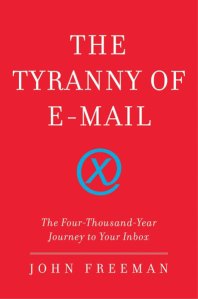
Summary: The communication patterns resulting from internet connectivity (primarily represented by email) are unlike anything humans have ever encountered before, and they are killing us.
That message is not particularly novel, complaints about email are nearly as ubiquitous as email itself. Nor is the last chapter of advice for dealing with it anything that has not been written on productivity blogs for years. That said, you should read it.
The core of the book traces the development of communication, primarily examining the speed with which we have been able to exchange information. Freeman writes well, making the story interesting and engaging. Most importantly, it puts the last 15 years of the internet into a little bit of context, which is an angle I have not read elsewhere.
As a result, the call for slowing down communication at the end has greater weight than that from a techno-phobe or productivity guru. In light of how we are wired, constant, rapid-fire communication appears to have no benefit and plenty of detriments to our social and psychological well-being.
Read the book, slow down, and talk to someone without a keyboard.

